Guide
Birds and migration: walking in order to watch
At Vendicari flamingos are counted in hundreds and the numbers sit in a public form; over the Strait of Messina the raptor passage is a spring event, not an autumn one.
Sicily lies between two continents, and everybody writes that, but on its own it is not much use. What changes an outing is knowing which species stops where, in which month and in what numbers, because those figures exist and are public, and almost nobody goes and gets them.
Vendicari: what is in the pools, and how much of it
The Riserva Naturale Orientata "Oasi faunistica di Vendicari", a managed nature reserve, was established by decree no. 81 of the regional department for land and environment of 14 March 1984, and it has been a wetland of international importance under the Ramsar Convention since 11 April 1989, with reference number 7IT043. It then falls within the "Pantani di Vendicari e di Capo Passero" Important Bird Area and within special protection area ITA090029, which covers 3,559 hectares across the pools of Vendicari, Morghella, Marzamemi and Punta Pilieri, so the figures in the data form apply to that perimeter and not to the reserve alone.
The Natura 2000 standard data form for that special protection area, in the version exported on 20 January 2026, lists 89 bird species of EU interest for the site, and for many of them gives a numerical estimate. The greater flamingo (*Phoenicopterus roseus*) is given with 300-1,300 individuals in concentration during passage and 200-800 wintering. The black-winged stilt (*Himantopus himantopus*) breeds with 20-80 pairs, while the little tern (*Sternula albifrons*) reaches 90-150 pairs, which is the highest number on the whole form. The avocet (*Recurvirostra avosetta*) breeds with 5-10 pairs and passes with 5-50 individuals, the spoonbill (*Platalea leucorodia*) passes through with 50-100 individuals and some twenty winter. The coot, on the other hand, winters with 600-1,200 individuals.
Among the raptors, the marsh harrier (*Circus aeruginosus*) appears as a wintering bird with 5-10 individuals, so it is a bird to look for in winter, above the reed beds, and not in August. The osprey (*Pandion haliaetus*) passes with 5-10 individuals and one winters. The white stork (*Ciconia ciconia*) is given in transit with 5-20 individuals and the black stork (*Ciconia nigra*) with 1-10: small numbers, so much so that planning an outing for the storks is not realistic. The crane passes through with 10-100 individuals and a handful winter. Then there are the species that make Vendicari what it is, namely the ferruginous duck, which breeds with 5-12 pairs, the marbled teal with 1-2, the stone-curlew with 10-20 and the Kentish plover with 20-40.
How many species in all have been recorded in the reserve is a question with a less clear answer than it looks, because the figures that circulate run from 180 to 245 and none of them arrives with a consultable census attached. The list of 89 species in the data form is partial by definition, since it covers only those protected by the Birds Directive, but it is the only number with an authority and a date behind it. For comparison with a figure stated by the people who run a site: at the Riserva Saline di Priolo, 52 hectares a few tens of kilometres to the north, LIPU states 216 species recorded, about 40 per cent of those observed in Italy.
The calendar, month by month
Autumn passage does not begin in autumn. Waders are already numerous by late June and their passage is most obvious in July and August. The peak of migration for herons and the other large waterbirds is in September instead, with daily counts of hundreds of grey herons. Ducks stay scarce until the end of October, after which there is a clear passage along the east coast, with daily totals of a thousand birds and sometimes more. Gull movements are substantial along the south-east coast from the end of October to mid-November, while cranes have an autumn passage in western Sicily, peaking between late October and early November.
The bee-eater (*Merops apiaster*) follows a calendar of its own, and it is the species most often put in the wrong season. The ISPRA atlas places the spring migration between late April and late May and the autumn one between mid-August and early October, preceded by dispersive movements that start as early as late July. Anyone looking for it in July, then, is not in the wrong month. Between 7,000 and 13,000 pairs breed in Italy. The turtle dove, by contrast, passes between mid-April and mid-May, with the largest concentrations on the south coast, on the Strait and on the islands.
Why people come back disappointed in August
Vendicari gets less than 400 mm of rain a year. The monthly maximum is just over 60 mm and falls in October, December and January, while from June to August the values are close to zero. The mean temperature in August is 26.2 °C, and the site’s Ramsar sheet gives a mean depth for the pools of 50 centimetres. These are shallow waters fed by rain and by seawater seeping through the sand bar, so with that depth and that rate of evaporation they draw back in summer. In the same period human pressure is at its highest, since a study by the University of Catania cites a conservative estimate of more than 120,000 visitors on the reserve’s beaches in 2014 alone.
Three different habitats, not three versions of one
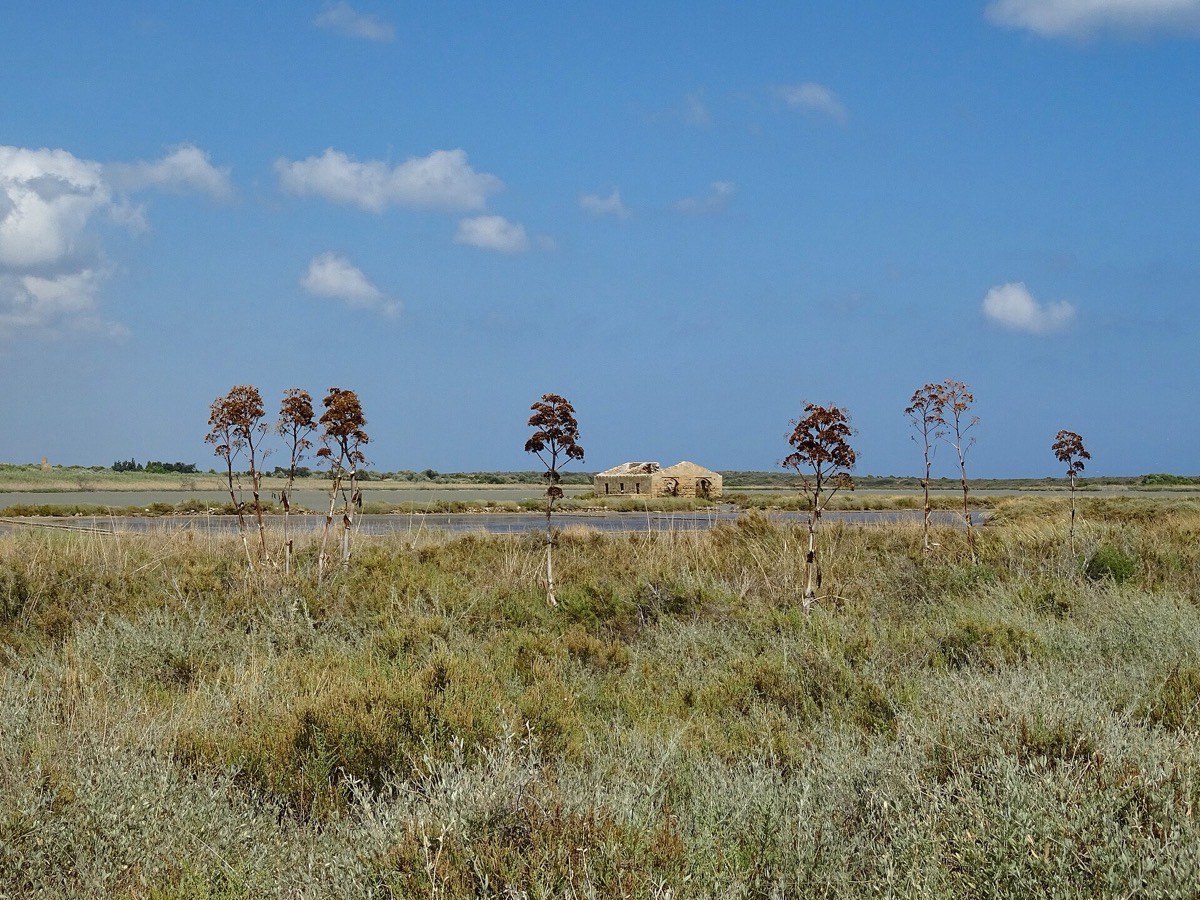
The pools of Vendicari are natural brackish hollows behind the dune bar, flooded from time to time by rainwater mixed with seawater, so the weather sets the level. For this complex the data form for the special protection area records the highest Sicilian numbers of herons and sandpipers, with abundant passage of ducks and geese.
The salt pans of Trapani and Paceco are the opposite, that is artificial basins at a controlled level, where the salt crystallises in summer. There is water there when there is none at Vendicari, and that is why the two destinations are not substitutes for one another. The reserve covers 986 hectares, is run by WWF Italia and is included in special protection area ITA010028 "Stagnone di Marsala e Saline di Trapani", 3,731 hectares of land and sea. The WWF states more than 240 bird species documented and about 450 salt-tolerant plant species, while the avocet is the reserve’s emblem and breeds there. Guided visits are booked in advance and take place on Wednesdays, Fridays and Saturdays.
The Stagnone di Marsala adds a third element that Vendicari does not have, namely a true lagoon, with meadows of *Posidonia oceanica*. It was included as early as 1980 among the areas of high international ornithological value, and in 1989 in the European list of areas of particular ornithological importance.
Torre Salsa is not a wetland, and that is the commonest misunderstanding when it is lined up with the others. The WWF reserve covers 762 hectares between Siculiana Marina and Eraclea Minoa, inside Natura 2000 site ITA040003, 1,464 hectares. The coast is made of marly limestone, globigerina marls, gypsum beds and clay badlands, with some of the most intact dune systems in Sicily, while the wetland is a single one, the "Pantano" crossed by the Salso stream. The data form describes the site as important as a stopover and as a migration route in both spring and autumn, and records the bee-eater passing through. One detail says the difference better than any adjective: the calandra lark (*Melanocorypha calandra*) is given as present all year at Torre Salsa, while the Vendicari form notes its recent disappearance from the reserve.
The Strait of Messina is a spring matter
Here the mistake is almost the rule, because the migration that really concentrates over the Strait is the spring one. A bird survey report filed in the Ministry’s environmental assessment portal is explicit: over the Strait of Messina the autumn migration of raptors is barely noticeable, because in autumn the raptors follow a different route from the spring one. A good number of black kites and honey buzzards cross central-eastern Sicily in autumn, converging on the islands of the Sicilian Channel. Most of these birds arrive having crossed the Tyrrhenian, Corsica and Sardinia.
In spring the picture changes. In 2025, between 15 March and 15 May, more than 60,000 raptor passages were counted on the Sicilian side of the Strait, concentrated on the days with a favourable wind and with peaks of up to 8,000 in a single day. The all-time daily record, though, is 9,729 raptors, on 5 May 2000. Among the species counted are honey buzzard, black kite, lesser kestrel, red-footed falcon, hobby, pallid harrier and Montagu’s harrier, osprey, griffon vulture, golden eagle and peregrine.
The Strait is not the only spring passage in Sicily, and the same report says so: no less important is the passage over Monte Pellegrino and the headlands near it, over Monte San Calogero, over the Madonie and over the Nebrodi. Other migrants cross the Tyrrhenian on the route that runs from Ustica to the Tuscan and Lazio coasts, or follow the Aeolian route. For walkers this matters, because in spring the raptors can be seen from high ground you can reach on foot, and not only from the watchpoints in the Peloritani.
The hides, the ticket, the opening hours
The observation hides at Vendicari stand on the edges of the pools and are marked on the interactive map published by the reserves website, whose legend also includes an entry for "accessible paths". No special permit is needed to use them, but the reserve ticket is. The fare, set by departmental decree no. 85/Gab of 18 March 2015, is 3.50 euro full, 1.50 reduced and 7.00 for the family ticket, with electronic payment only at the entrances and valid on the day of issue. Entry is free for children under 8 and for people with disabilities together with a companion, while study, research and teaching activities require authorisation from the managing authority.
The distances from the entrances are short, and that is what makes Vendicari suitable for anyone who does not want to put in the kilometres. From the Vendicari entrance to the beach is about 500 m, from Cittadella 300 m to the Case Cittadella and 3.5 km to the Tonnara, from Calamosche 1,200 m, from Eloro about 300 m. The hours are seasonal, and the entrances close an hour before the reserve does: in the winter months the reserve opens at 9.30 and closes at 16.00, while in April and May it runs from 7.00 to 19.30. These are figures that change, so checking the authority’s website the day before remains the only check that works.
On whether the hides can be reached by anyone with mobility difficulties there is no published information. The map distinguishes accessible paths, but it does not state which hides can be reached or on what surface, so anyone who needs that information has to ask the Servizio per il territorio di Siracusa, the provincial office that runs the reserve.
The rules
The reserve’s regulations, with the rules of use and the prohibitions, were approved by departmental decree no. 821 of 30 May 1987. The official website does not publish the full text, only partial requirements, for example that on the beach only a parasol, a beach towel and a swimming aid are allowed, and not sunbeds, chairs, tents, inflatables or games. Dogs are given as banned by several sources that agree with one another, but we have not found the ban in a document from the authority: anyone travelling with a dog should check beforehand, because at Vendicari there is no way of putting it right at the entrance.
Distance is not a courtesy. A migrating bird at a stopover is rebuilding fat reserves, so every unnecessary flight is energy taken from a journey of thousands of kilometres. It counts double in breeding areas, where putting an adult to flight means leaving eggs or chicks to the sun and to the gulls. At Vendicari the main beach has stretches closed off for *Caretta caretta* nesting, while the Kentish plover nests on the ground, on the sand, where nobody expects a nest. For drones the ENAC rules apply, and the flights made in 2015 to monitor the reserve required a certified pilot and insurance, since they were not a recreational activity.
Real cases
Case
The flamingos of Priolo, and the fireworks
The Riserva Saline di Priolo, 52 hectares run by LIPU inside the petrochemical complex near Siracusa, is the site of the first documented breeding of the greater flamingo in Sicily.
- The first breeding takes place in 2015; reports at the time speak of about 70 pairs, some fifty nests and 36 chicks.
- The colony then abandoned the site, and in the Regione Siciliana statement of 28 May 2025 the return to breeding is described as such after three years of absence.
- The account given in the statement puts the abandonment down to fireworks set off nearby.
- In the same reserve LIPU states 216 bird species recorded, about 40 per cent of those observed in Italy, and the breeding of ferruginous duck, shelduck and shoveler.
What this tells you. A single episode of disturbance, lasting minutes, can cost a site a colony for years. It is the concrete reason behind the rules on distance, and it is not only about fireworks: it is also about a drone, a loose dog, somebody climbing a fence for a photograph.
Walking with a dogCase
Forty years of counts on the Strait
Since 1984 an observation and anti-poaching camp has been held every spring on the Strait of Messina, set up after systematic shooting of migrating raptors was documented in 1981.
- At the first camp, in April 1984, 3,198 raptors were observed and 1,187 shots counted.
- In 2022, 52,289 raptors were counted and no shots.
- On 5 May 2000 the daily record of 9,729 raptors was set.
- In 2025, between 15 March and 15 May, the count on the Sicilian side passed 60,000 passages, with peaks of up to 8,000 a day on days with a favourable wind.
What this tells you. The series says two things at once. The first is that the event concentrates into a few days: anyone who goes at random comes back with little, anyone who watches the wind comes back with plenty. The second is that the numbers are also rising because somebody stayed there counting for forty years.
Alcantara and PeloritaniFrequently asked questions
Do you need a permit to go birdwatching at Vendicari?
No. You need the reserve ticket: 3.50 euro full, 1.50 reduced, 7.00 family, with electronic payment only at the entrances and valid on the day. The fares are set by departmental decree no. 85/Gab of 18 March 2015. Authorisation from the managing authority is needed instead for study, research and teaching activities, and for visits by groups and school parties it has to be requested in advance.
How far is the walking, and can the hides be reached with mobility difficulties?
The distances are short: about 500 m from the Vendicari entrance to the beach, 1,200 m from Calamosche, 300 m from Eloro, 3.5 km from Cittadella to the Tonnara. The official map of the reserve distinguishes accessible paths, but it does not state which hides can be reached or on what surface, and we have not found that information published anywhere else. It has to be asked of the Servizio per il territorio di Siracusa. Entry is free for people with disabilities together with a companion.
Can I bring my dog?
At Vendicari the ban is reported by several sources that agree with one another, but the text of the regulations, approved by departmental decree no. 821 of 30 May 1987, is not published in full by the authority: it is worth checking before setting out, because there is no remedy at the entrance. The other areas have rules of their own and each has to be checked with its manager, which at Torre Salsa and at the Trapani salt pans is WWF Italia and not the regional government.
Is it a suitable outing for children?
The distances yes, the manner of it depends. In a hide you sit still and quiet for long stretches, which is the opposite of how a walk with children works. The practical compromise is the time of day: first light or the last hour, when the birds are active and the wait is shorter. From June to August you have to reckon with little water in the pools and therefore little to see.
Which month do I choose if I can only go once?
It depends what you want to see, and it is a hard choice. For waders, July and August, when at Vendicari the water is short and the Trapani salt pans work better. For herons, September. For ducks and gulls, from the end of October to mid-November. For wintering birds, flamingos and marsh harrier, from December to February. For raptors on the Strait, April and May, picking the day by the wind.
Can you get there without a car?
We do not know, with a source. The reserve’s website describes the five entrances and their car parks, but it does not publish public transport connections, and we have not found a verifiable bus timetable for the Vendicari, Calamosche or Cittadella entrances. Before counting on a bus, ask the Servizio per il territorio di Siracusa or the comune of Noto.
The population figures for Vendicari come from the Natura 2000 standard data form for special protection area ITA090029, exported on 20 January 2026 and published by the Ministry of the Environment. The months of passage come from the Atlas of bird migration in Italy (ISPRA) and from a bird survey report filed in the environmental assessment portal. Fares and opening hours are those published by the website of the reserves run by the Regione Siciliana and consulted on 4 September 2026: they change, so they are checked before setting out. Where we did not find a source, we say so.
Written and checked by the Redazione Sentieri Siciliani. Published on 1 September 2026, updated on 2 September 2026. How we work.
Sources
- Ministero dell’Ambiente e della Sicurezza Energetica, the Italian ministry for the environment and energy security — legislation on protected areas and environmental protection
- ISPRA, the national institute for environmental protection and research — protected areas, biodiversity and environmental data
- LIPU, the Italian league for bird protection — birdlife, migration and responsible birdwatching
- Regione Siciliana, the Sicilian regional government — regional orders, nature reserves and state forest land
- European Environment Agency — European data on climate and the environment
Where to go from here
Next step
From the principles to the places
Rules are worth little until they apply to a precise spot. From here you reach the pages with access points, parking and tracks.