Guide
What ground you walk on in Sicily
Polished limestone, volcanic sand, karst rock, muddy forest roads. Four surfaces that call for four different ways of walking, and that decide your footwear more than the altitude does.
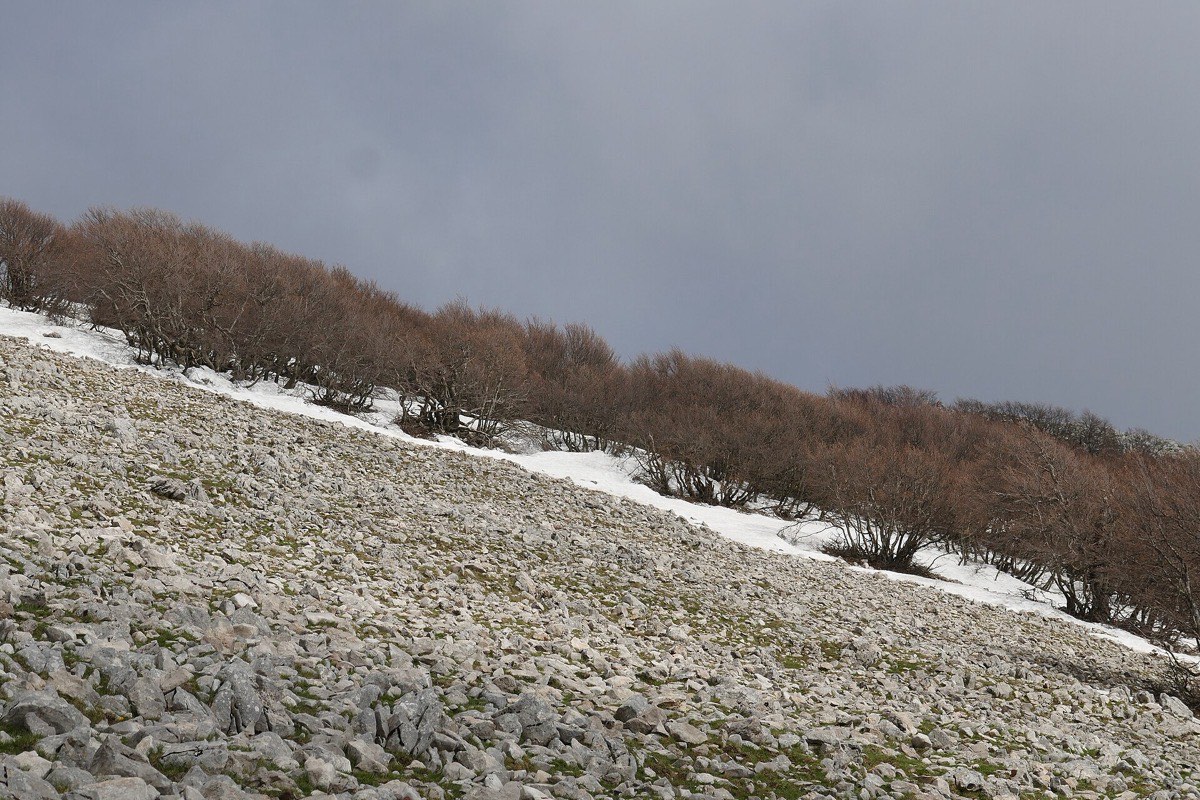
This is another of the questions that comes up for every area: what sort of ground should I expect? In Sicily the answer changes radically from one province to the next, far more than it does in the Alps, because the island puts an active volcano, limestone mountains and karst plateaux together within a few tens of kilometres.
Coastal limestone
This is the ground of Zingaro, of Monte Cofano, of Capo Gallo, of much of the Palermo area. Pale rock, often polished by the passage of feet, with stretches of loose scree. Going up it holds well; coming down, especially on worn slabs like those of the Scala Vecchia on Monte Pellegrino, it is more slippery than you expect.
It has a second property that has nothing to do with your feet: it is pale, and it reflects. The radiation comes up from below as well, and the temperature you feel rises several degrees above the air temperature.
Volcanic sand and lava
On Etna the ground changes in kind. Volcanic sand gives way under the foot and going up it costs energy like the sand of a dune; solidified lava is sharp and abrasive, and it eats soft rubber compounds. High boots make sense here, not for the ankle but to keep out the fine material, which gets in everywhere.
The karst plateau
High on the Madonie the problem is not grip but reading the ground. Karstified limestone breaks through in slabs and rubble, sinkholes open up hollows that can be tens of metres deep, and the vegetation can hide their edges. Off the path you are walking on ground where an ankle turns quickly.
Forest roads
In the Nebrodi, at the Ficuzza and across much of the lower Madonie the surface is beaten earth, wide and gently graded. It is the easiest ground on the island, and that is why those areas are the best for anyone starting out or walking with children. The only problem is water: after rain the roads hold the damp for days and turn muddy.
What footwear do you need on each surface?
The practical rule is that in Sicily you choose your footwear for the rock, not for the region. A deep-lugged sole and a low shoe are fine on limestone and forest roads, which are most of the routes. On Etna you need something sturdier and preferably high. In the gorges with water in them, from the Alcantara to Cavagrande, you need a shoe that can get wet and that grips when wet.
One real case
Case
Same ascent, two different efforts
A comparison between the climb to the Fossa delle Felci and the Ficuzza circuit.
- The stretch of path 5 going up from Santa Marina Salina covers 1.9 km and goes from 111 to 611 m, about 500 m of ascent, without reaching the top: a very high average gradient, on damp ground in the wood.
- The Ficuzza route towards the Gorgo del Drago covers 3.6 km with 126 m of ascent, between 644 and 750 m: a wide forest road, in shade.
- The first packs three times the ascent into half the length, on ground that stays wet for a long time.
What this tells you. Two routes both under four kilometres, and one is an outing while the other is a training session. Before looking at the length it is worth looking at the average gradient, that is the ascent divided by the kilometres, and then at the surface.
The climb to the Fossa delle FelciFrequently asked questions
Do you need high boots in Sicily?
Hardly ever. On coastal limestone and forest roads a low walking shoe with a deep-lugged sole is enough. The exception is Etna, where volcanic sand gets in everywhere and the lava is abrasive: there, high boots make sense.
Why does limestone slip on the way down?
Because feet polish it. On heavily walked stretches, and in particular on the historic paved mule tracks, the surface turns glassy and loses grip with dust or damp on it. It is the reason why the sole matters more than the model of shoe.
What are the sinkholes of the Madonie?
Closed hollows dug out by the dissolution of the limestone, in places tens of metres deep. On the Pizzo Carbonara plateau there are many of them and their edges can be masked by vegetation: it is one of the reasons why walking off the path up there is advised against.
The classification follows the geology of the areas the published tracks fall in and is consistent with the “what to take” fields filled in on the individual pages.
Written and checked by the Redazione Sentieri Siciliani. Published on 1 September 2026, updated on 1 September 2026. How we work.
Sources
- ISPRA, the national institute for environmental protection and research — protected areas, biodiversity and environmental data
- Parco dell’Etna, the Etna park authority — the park rules, the authorised paths and access to the volcano
- Parco delle Madonie, the Madonie park authority — the path network, the rules and the state of the routes in the Madonie
Where to go from here
Next step
From the principles to the places
Rules are worth little until they apply to a precise spot. From here you reach the pages with access points, parking and tracks.