Mountain · Palermo and around
Rocca Busambra: the wall above the Ficuzza woods, access and safety
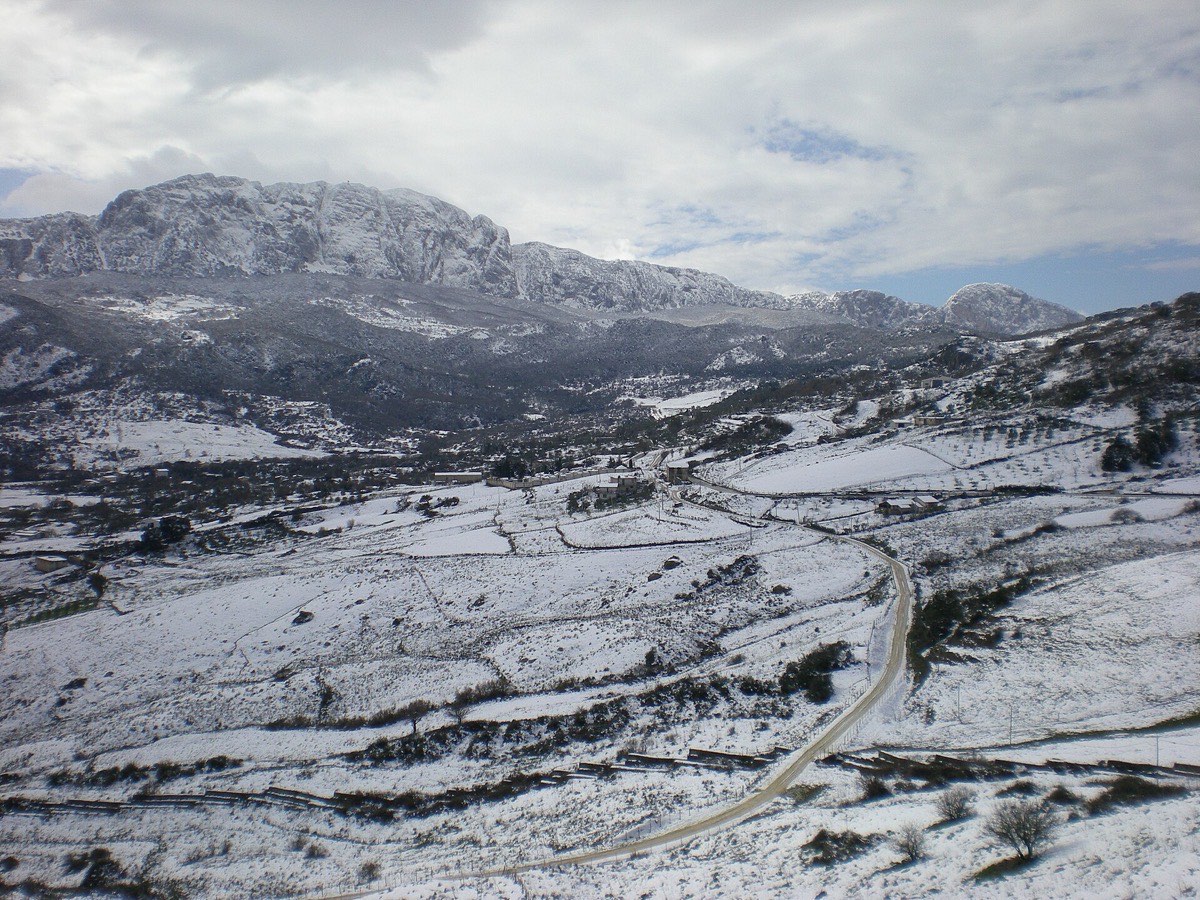
Rocca Busambra is the limestone and dolomite massif that closes off the Bosco della Ficuzza, the Ficuzza woods, to the south, some forty kilometres from Palermo: 1,613 metres at the top, the highest point in western Sicily. It lies inside the Riserva naturale orientata Bosco della Ficuzza, Rocca Busambra, Bosco del Cappelliere e Gorgo del Drago, a managed nature reserve of 7,398.30 hectares established by a decree of the regional councillor for land and environment of 26 July 2000 and managed today by the regional department for rural and territorial development, the former Azienda foreste demaniali, the state forestry agency.
The first thing to say concerns the summit: no authority publishes a route up it. When we read them on 20 October 2026, the reserve’s official pages listed only two routes, stages V10 and V11 of the Sentiero Italia CAI, the Italian long-distance trail, and both stay in the woods. The summit ridge is a crest looking down a wall several hundred metres high, the last stretch is walked over grassland and rock with no obvious path, and in October 2022 the fire brigade lifted three walkers off the mountain by helicopter. Anyone who cannot move off-path on exposed ground should not go up here.
A figure that circulates wrongly also needs correcting. The 1,613 metres is the height above sea level, not the height of the wall: on the digital elevation model we use to calculate our profiles, from the foot of the rock, at around 1,150 metres, to the top there is a little over four hundred metres, and below that the slope falls more gently to the nine hundred metres of the woods. And it is the highest summit in western Sicily, not in the province of Palermo: in the Madonie, in the same province, Pizzo Carbonara reaches 1,979 metres.
Anyone who gives the summit a miss still has a full day’s walking. The foot of the wall can be followed on forest tracks starting from the village of Ficuzza, at 682 metres, and the wood below is the largest forest complex in western Sicily. The track published here nearby, from the old Ficuzza station towards the Gorgo del Drago, measures 3.6 kilometres between 644 and 750 metres: an hour and a quarter on the way out, on shaded ground.
A page by the Sentieri Siciliani editors
Before you go
Checked on 20 October 2026 · source: Sicilian Region, regional decree of 26 July 2000 with the reserve’s rules (ORBS portal) and pages of the managing authority, the department for rural and territorial development- Entrances
- Ficuzza, Real Casina di caccia 37.8822, 13.3769 Height 682 m. Free parking in the village, on the north side. This is the way into the woods and to the foot of the wall, not to the summit.
- La Casotta, clearing on the forest track 37.8691, 13.3850 Height 853 m, about a kilometre and a half south of Ficuzza, where the track comes close to the foot of the mountain. Clearing, fountain and cattle trough mapped on OpenStreetMap; we have not checked whether the track can always be driven.
- Portella del Vento 37.8444, 13.4387 A pass at 1,120 m on the eastern side, from which the lower flanks are climbed. It can only be reached on gravel tracks, to be judged on the spot.
- Parking
- Free parking at Ficuzza, in front of the Real Casina, plus a second free clearing in the village. Higher up there are no car parks: you leave the car in the widenings along the forest tracks, with no facilities and nobody watching it.
- By public transport
- No service towards the mountain. The village of Ficuzza is served by the intercity buses between Palermo and Corleone, with few runs a day: on 20 October 2026 the operator’s site could not be reached and we could not check the timetable at source. From the bus stop to the foot of the wall there are still more than two kilometres as the crow flies, and more along the tracks.
- Water
- None high up. Fountains in the village of Ficuzza and a trough with a fountain at La Casotta, neither of them declared drinkable by any authority: carry it from home.
- Shade
- Excellent in the wood at the foot, none on the ridge. Above the tree line you walk over grassland and rock with no cover at all.
- Permits
- For walking in the reserve area the rules of 2000 require no authorisation (annex 2, Article 1.1, letter l), but they forbid leaving the paths specially laid out (Article 2.1, letter s) and allow the managing authority to restrict or close areas (Article 7). Authorisation from the authority is needed for scientific research and for entering the cavities (Articles 5 and 10), and for flying over the area.
- With children
- No
The summit and the summit ridge are out: exposed ground, fissures hidden in the grass, no waymarked route. With children you stay in the wood at the foot, where the circuits round the Real Casina are easy and shaded.
- With a dog
- With conditions
The regional decree of October 2025 allows dogs on a lead only on the paths identified by the managing authority and never in Zone A: ask the department for rural and territorial development for the list. On the tracks at the foot, watch out for grazing livestock and sheepdogs.
- Entry fee and opening hours
- We do not publish fees and opening hours that we have not checked at source this season. They should be checked with Sicilian Region, regional decree of 26 July 2000 with the reserve’s rules (ORBS portal) and pages of the managing authority, the department for rural and territorial development before you set out.
The practical details for Rocca Busambra change over time. If you find something that does not match, please tell us.
What to expect
The founding decree describes the Busambra as an isolated massif of Numidian flysch and Triassic limestone and dolomite, and protects it for exactly that reason: its structure and its aspect make it a refuge for cliff endemics, among them Centaurea busambarensis and a variety of Gagea that carries the mountain’s name. At the foot of the Rocca the decree notes some of the few Sicilian stands of deadly nightshade. Seen from the north the mountain is one continuous barrier running east to west; on its eastern side it steps down through knolls that each have a name of their own, Cozzo Tondo at 1,092 metres, Portella del Vento at 1,120, Cozzo Fanuso at 1,033.
The line of the ridge is not a point but a band of grassland and rock, and the least visible danger is right there: the limestone is karst, pierced by fissures and swallow holes that the long grass hides. How deep they are is told by a well-known story. In March 1948 the body of the trade unionist Placido Rizzotto was thrown into a cavity on the Busambra; part of the remains was recovered in December 1949, the rest only in 2009, with firefighters trained in caving, and the identification came in 2012. The reserve’s rules forbid damaging or blocking swallow holes and natural cavities and leave access to the underground sites in the hands of the managing authority, where only scientific work is allowed.
On the ways up, this page gives no figures, because the site has no track of its own for this mountain and because the managing authority publishes no routes. What is known is this. From the north you reach the foot of the wall on forest tracks that start at Ficuzza and pass the clearing at La Casotta, at 853 metres; higher up, collaborative mapping marks a path running along the foot of the wall and classes it as not visible on the ground. From the east the side with the knolls is lower and more open, and can only be reached on gravel tracks. The only public description of a guided ascent we have found is the programme of a club outing by the CAI in Palermo in October 2016: it gives the south side, the way past Piano Tramontana and two leaders. None of these routes corresponds to a numbered, waymarked path.
The rules attached to the decree of 2000 say two things that have to be read together. In the reserve area, walking is free and requires no authorisation, as Article 1.1, letter l, establishes. Among the prohibitions under the same heading, though, is the one on leaving the paths specially laid out, at Article 2.1, letter s, and Article 7 allows the managing authority to set limits and conditions up to closing some areas to visitors altogether. The list of the paths that have been laid out does not appear to be published anywhere: that is the question to put to the department before going up, above all for a route that leaves the tracks.
The wall is nesting ground and the decree makes that plain: among the populations to be protected it lists golden eagle, peregrine falcon, Egyptian vulture, colonies of lesser kestrel, black and red kite and red-billed chough, and it obliges the managing authority, once the presence of species protected by the Habitats Directive is established, to ban activities that disturb breeding. There are climbing routes on the wall, put up and documented, which are a different activity with different equipment: anyone looking for them has to ask the authority whether and when nesting restrictions apply. For the same reason the rules forbid flying over the area in unauthorised aircraft, except for rescue and surveillance, and list hang-gliding among the sports that are not allowed.
High up there is no water. Ficuzza has fountains, facilities and a picnic area, and a trough with a fountain is marked at La Casotta, along the track: none of these points is declared drinkable by any authority, so water has to be carried from home, all of the day’s supply. In summer the ridge is a trap, because it combines grassland without a thread of shade, rock that throws the heat back and nowhere to refill. There is fire, too: on 9 August 2021 thirty-five scouts out walking between Massariotta and Arcera, on the Marineo side, were cut off by a fire and found by the Ficuzza forestry staff, while a Canadair water bomber and three helicopters stopped the flames at a firebreak.
On the summit plateau navigation is the real problem: few features, uniform grass, and in fog the ridge becomes a place where you take the wrong direction. The name of the eastern pass, Portella del Vento, the pass of the wind, says the rest: the ridge is the first barrier for the currents from the north, and the wind at the top is nothing like the wind in the woods. In winter the approach tracks hold mud for days after rain, the ridge can be iced or under snow, and the short days cut the margin, because the way back is long.
The Rocca stays the backdrop to everything you walk at Ficuzza, and this is the part of the mountain open to anyone. The wood at its foot is cool in the height of summer, it has the Real Casina di caccia, the royal hunting lodge, in the middle of the village, and a network of tracks that allows circuits of very different lengths. The two Sentiero Italia stages published by the reserve, the V10 coming down from the north to Ficuzza and the V11 from Ficuzza towards Cefalà Diana, cross the area without going to the summit, and on the V10 the CAI sheet reports a stretch in poor condition and partly collapsed towards the trunk road, near Ponte Arcera. Hunting is banned throughout the reserve, buffer zone included: it is one of the few large areas inland from Palermo where in autumn you are not walking among the shoots.
When to go
- April to early June: the grass is still short, the cliff plants are in flower and the temperature allows a long day.
- October and November on dry, clear days. After the first rains the approach tracks stay muddy for days.
- In summer the ridge is to be avoided: no shade, no water and the fire season. The wood at its foot, on the other hand, is good walking.
- In winter only with settled weather and the forecast checked: mud, ice on the ridge, frequent fog on the plateau and little light.
What to take
- GPS track and maps. There are no signs on the mountain you can count on.
- Boots with a stiff sole and above the ankle: polished limestone, unstable scree and sloping grassland.
- All the day’s water. High up there is nowhere at all to refill.
- A windproof layer even in summer: the wind on the ridge is not the wind in the woods.
- A charged phone, and your route left with someone down in the valley. The number for rescue is 112.
- The summit ridge is exposed: the wall falls several hundred metres, with no barriers and no signs, and the last stretch is done over grass and rock with no obvious path. There is no standard route described by any managing authority: anyone without experience of exposed ground should go with a CAI section or with a guide.
- The summit plateau is karst, with fissures and swallow holes hidden by the long grass. Walk watching where you put your feet and do not go into any cavity: the reserve’s rules leave the underground sites in the hands of the managing authority.
- In the reserve area the rules forbid leaving the paths specially laid out, and the managing authority can close areas to visitors at any time. The list of paths is not published: ask the department for rural and territorial development.
- Rescue is a long way off. In October 2022, for three walkers stranded on the Rocca, it took a fire brigade helicopter flown in from Catania. Phone coverage on the mountain is not guaranteed.
- Camping and bivouacking are forbidden in the reserve area, and in the buffer zone they are allowed only in the equipped areas. Open fires are forbidden outside farming, forestry and grazing work.
Frequently asked questions
How high is Rocca Busambra?
One thousand six hundred and thirteen metres above sea level, and it is the highest summit in western Sicily. It is not, however, the highest in the province of Palermo: in the Madonie, in the same province, Pizzo Carbonara reaches 1,979 metres. The wall needs correcting too: the 1,613 metres is the height of the summit, while the rock rises a little over four hundred metres above its foot, at around 1,150.
Can you climb to the summit of Rocca Busambra?
People do climb it, but it is not a walk for everyone and no authority publishes a route to the summit. The summit ridge is exposed, the last stretch is walked over grass and rock with no obvious path and there are no signs. Anyone without experience of off-path ground should go up with a CAI section or with a guide. At the foot, on the other hand, the walking gives no trouble.
How long does it take to reach the top?
We do not publish that, because we have no track for this mountain and the managing authority releases no figures on the routes. The one solid number is the height difference: between the village of Ficuzza, at 682 metres, and the summit there are about 930 metres of climb, and the foot of the rock is at around 1,150.
Do you need a permit, or pay for a ticket?
The managing authority publishes no charges and no opening hours: there are no gates and no ticket offices, and the decree provides for no paid entry. Walking in the reserve area is free, but the rules forbid leaving the paths specially laid out and the authority can close areas to visitors: before a route that leaves the tracks it is worth writing to the department for rural and territorial development.
Is Rocca Busambra suitable for children?
Not the summit, and not the ridge either: exposed ground and karst fissures hidden in the grass. The wood at the foot, yes, and it is one of the best choices in the province for a family day out, with the short, shaded circuits round the Real Casina di caccia.
Can you bring a dog?
It depends on the path. The regional decree of October 2025 allows dogs on a lead only on the routes identified by the managing authority and excludes them from Zone A areas, and the list for this reserve has to be asked for from the department for rural and territorial development. On the tracks at the foot there are grazing livestock and sheepdogs.
Can you get to Rocca Busambra by public transport?
Not as far as the mountain. The village of Ficuzza is served by the intercity buses between Palermo and Corleone, with few runs a day, and from there more than two kilometres of tracks are left just to get below the wall. On 20 October 2026 the operator’s site could not be reached, and the timetable has to be checked by phone before setting out.
Can you fly a drone over Rocca Busambra?
No, not without authorisation. The reserve’s rules forbid flying over it in unauthorised aircraft, with the exception of rescue and surveillance flights and of what the air navigation rules allow. The wall is also a nesting site for golden eagle and peregrine falcon, and the managing authority is obliged to ban activities that disturb breeding.
Why is Rocca Busambra tied to the story of Placido Rizzotto?
Because the body of the trade unionist from Corleone, killed in March 1948, was thrown into a cavity on the mountain. Part of the remains was recovered in December 1949, the rest only in 2009 with firefighters trained in caving, and the identification came in 2012. It is also why the plateau has to be walked with care: the fissures are deep and the long grass covers them.
Nearby
 Nature reserve
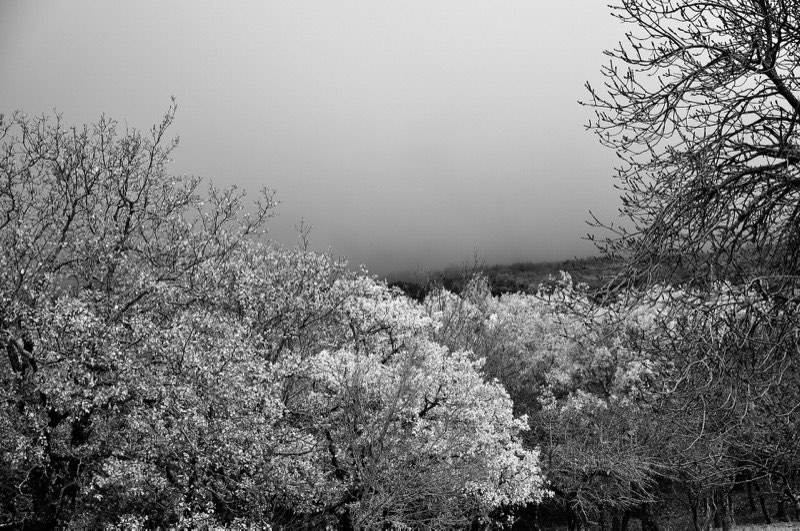
The largest forest complex in western Sicily, three quarters of an hour from Palermo, at the foot of the Rocca Busambra. Big, cool and surprisingly little walked.
 Mountain
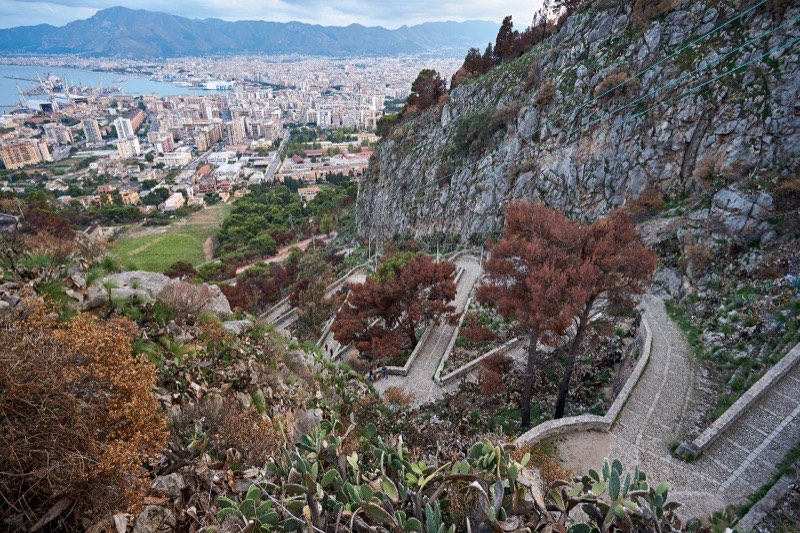
Six hundred and six metres of limestone above Palermo, with two historic stairways climbing it. It is the most walked city hike in Sicily, and a city bus takes you to it.
 Nature reserve
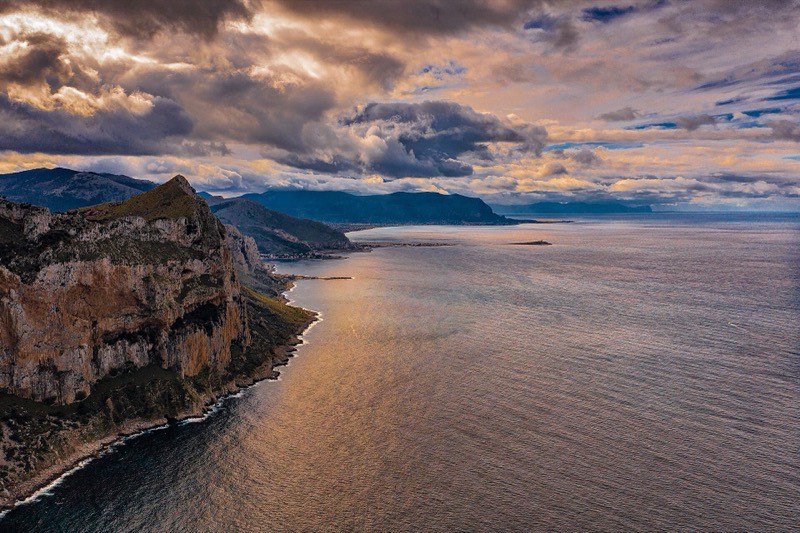
Five hundred and eighty-five hectares of limestone and garrigue on the headland between Mondello and Sferracavallo, inside the city boundary of Palermo. A city bus takes you there, and there is neither water nor shade.
Next step
See the rest of the area
We have no published track for this place yet. There are others in the area.