Guide
The cave of the Iblei on foot: tickets, opening hours and how you go down
In the Iblei you walk by going down, into the cave: narrow valleys cut into the limestone, which are gorges and not quarries. Which ones have a ticket and opening hours, which rules apply inside, how you plan the climb back out.
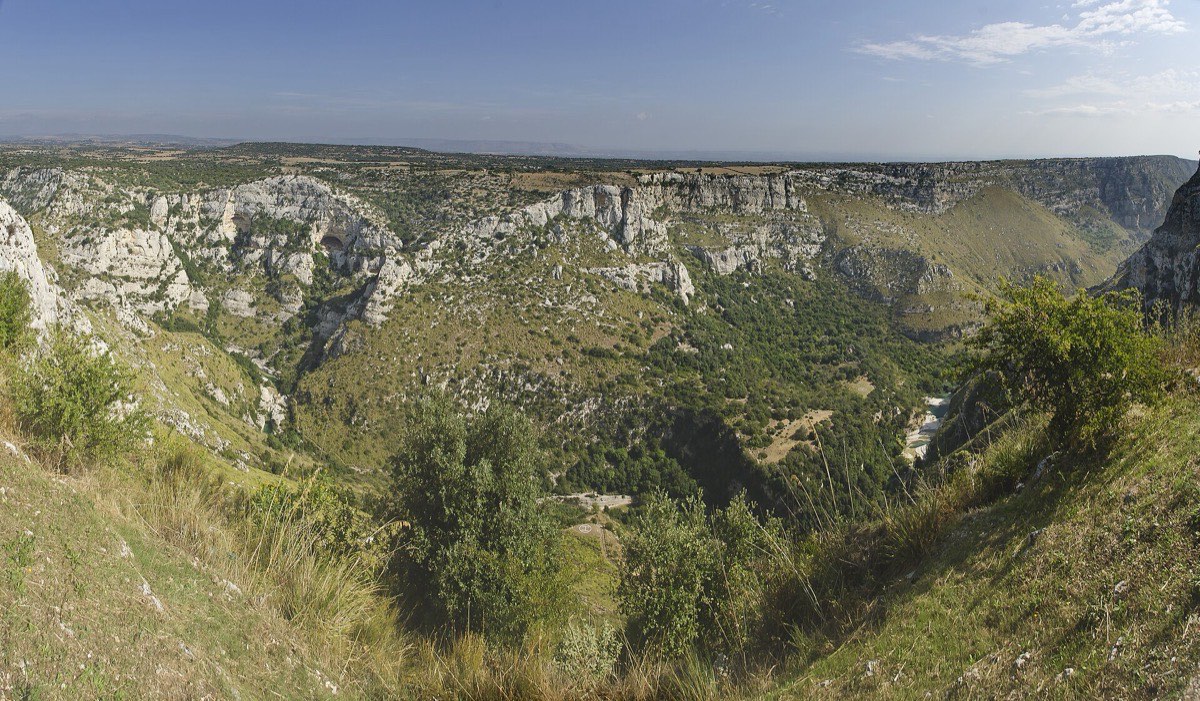
In the Iblei the path usually does not climb: it goes down. The typical landscape of south-east Sicily is a limestone plateau cut by narrow, deep valleys, which here are called cave, so a day out begins at the rim and ends with a climb. Here you will find which of them have a managing authority, a ticket and opening hours, which rules apply inside, and how to plan a day in which the hard work comes on the way back. Pantalica and Cavagrande have pages of their own, so here they are only referred to. The opening hours and prices are the ones published by the authorities and read on 17 September 2026.
What is a cava in the Iblei?
It is a river valley sunk into the tavolato, that is into the limestone tableland. The word itself misleads anyone arriving from outside, because in Italian a cava is normally a quarry: here it means a canyon, a gorge that water cut into the rock, and nothing was ever quarried out of it. The document on the physical structure of the territory of the Province of Ragusa describes a calcarenite complex, the Ragusa formation, which alternates rolling tablelands with narrow valleys of considerable size: in the valley of the Irminio the drop between the rim and the floor is more than 200 m. The explanatory notes to the Augusta geological sheet, published by ISPRA, call them fluvio-karst valleys, because they are carved both by run-off and by the dissolution of the limestone, along the fractures in the rock. And they take the form of canyons, gorges or ravines.
Why they are so deep is explained by those same notes. The tableland was largely out of the sea by the Messinian, and from the middle Pleistocene onwards the whole region rose, so that the watercourses cut into it. The record of the Pantalica reserve adds a detail that is useful to anyone walking, because the beds of limestone are not all the same: the purer ones resist and are shaped by karst, while the less pure ones erode sooner. That is where the stepped profile of many cave comes from, and so do the ledges along which the paths run.
The same alternation explains the water. According to the managing body of Pantalica, the poorly permeable beds at depth hold back a shallow water table that comes out along the cave as permanent springs, and that is why the floor is green while the plateau above is dry. It does not hold everywhere, though: in the valley of the Anapo the river disappears in places into swallow holes, so the streambed stays dry except in the strongest floods. It is no accident that the authority recalls that the name Anapo comes from a Greek word meaning invisible river.
The edges of the tableland are sharp as well, because what draws them is a system of faults: to the west between Comiso and Chiaramonte, to the south-east between Pozzallo, Ispica and Rosolini. The old centre of Ispica looks out over one of those faults, where the mouth of its cava opens. And the vertical walls are the reason these valleys have been lived in for thousands of years: rock-cut chamber tombs, cave villages, churches hollowed out of the rock.
Ticket or free access: the picture of the cave of the Iblei
Among the places in this guide three different regimes apply, and it is worth keeping them apart because they change what you can actually plan. Cava d’Ispica and the Parco della Forza are sites of the Parco archeologico di Kamarina e Cava d’Ispica, a body of the Regione Siciliana, so they have a ticket office, opening hours and a last admission. Cavagrande del Cassibile and Pantalica, on the other hand, are riserve naturali orientate, managed nature reserves, run by the Servizio per il Territorio di Siracusa, with monthly hours, a ticket at Cavagrande and no ticket, for now, at Pantalica. The third case is the Riserva Fiume Ciane e Saline di Siracusa, run by the Libero Consorzio Comunale di Siracusa, where the regulations allow access on foot to the paths along the river but the authority publishes neither hours nor prices.
The many other cave of the tableland have no authority publishing routes or rules of access, which is why we do not deal with them one by one. The fact that a valley has no gate does not mean that the floor of it may be walked freely, nor that the path is maintained, since with no authority nobody publishes either the one or the other.
Cava d’Ispica: the archaeological park between Modica and Ispica
For the Parco archeologico, Cava d’Ispica is a deep cut in the tableland about 13 km long, between Modica and Ispica, and in the eighteenth century it was already a stop on the Grand Tour. The authority lists cave villages such as the Grotte Cadute, the rock-cut churches of Santa Maria, San Nicola and della Spezieria, the Byzantine catacombs of the Larderia, a gymnasium of the Hellenistic period and a monumental prehistoric tomb. What the page does not say is which of these monuments lie inside the fenced area, so that has to be asked at the ticket office.
The archaeological area you pay for is at the Modica end, at the Crocevia Cava Ispica, and the ticket costs €6 full and €3 reduced, bought at the ticket office. As of 13 November 2026 the weekday hours run straight through from 9:00 to 16:30, with last admission at 16:00, while on public holidays it opens only in the morning, from 9:00 to 13:30 with last admission at 13:00: for November the authority gives the 1st, the 8th, the 15th, the 22nd and the 29th as public holidays. Since the hours shorten with the season and the calendar of public holidays comes out a month at a time, it has to be read again before setting out. For the public holidays in October, as of 17 September, the authority had not yet published the calendar.
The rules on reductions are those of the regional sites. Entry is free for anyone under 18, and under 12 an adult has to come along. Between 18 and 25 you pay half price, while the other free entries (disabled visitors and a companion, tourist guides, teachers and some categories of student) are obtained by showing a document. The same page mentions free entry on the first Sunday of the month, but immediately afterwards cites the suspension ordered in 2020, so before counting on it it is worth telephoning the Parco, on 0932 249432.
Beyond the fenced area the valley carries on for kilometres, but we have not found a route published by the Parco that crosses the whole of it, nor an official map distinguishing the stretches open to the public from those that are not. The Parco publishes no rule on dogs and gives no public transport connections. Anyone who wants to do more than the archaeological area should therefore ask the authority beforehand, and on the ground follow the signs.
Parco della Forza: the crag of Ispica at the mouth of the cava
At the southern mouth of the cava stands the spur of the Forza, a natural crag lived in from the early Bronze Age until Greek colonisation. It was reoccupied in 1169 and became the fortress of the town of Spaccaforno, razed by the earthquake of 1693, after which the town was rebuilt where Ispica stands today. Inside the park there remain the church of the Annunziata, partly cut into the rock, the Palazzo Marchionale and the Centoscale: a tunnel 250 m long that led safely down to the bed of the stream, because that is where the water was taken from.
The entrance is in via Cavagrande, at Ispica, and the ticket costs €4 full and €2 reduced, with the same free entries as Cava d’Ispica. Here, though, the weekday hours are longer than at Cava d’Ispica, from 9:00 to 19:00 with last admission at 18:30, read on 13 November 2026: the two sites of the same authority do not close at the same hour, so a day that takes in both has to be put together with care. In September 2026 Sunday the 6th, the 13th and the 27th were open all day, while 20 September was open only in the morning. The other public holidays then follow the morning hours, from 9:00 to 13:30.
Here the sun counts for more than it does at the bottom of a cava. From 22 to 26 July 2026 the Parco closed the Forza for the afternoon shifts because of the heat, and the reason given in the notice is that most of the visitor route runs along the spur, in open areas exposed to the sun in the middle of the day. So it holds in October too: on hot days the visit has to be done in the morning.
Fiume Ciane and Saline di Siracusa: the reserve on the edge of the city
The Riserva naturale orientata Fiume Ciane e Saline di Siracusa, a managed nature reserve, was established by a decreto assessoriale of 14 March 1984, covers 316.68 hectares in the comune of Siracusa and is run by the Libero Consorzio Comunale di Siracusa. According to the regional portal of protected areas it exists to protect the papyrus, which grows wild along the Ciane, and the wetland of the salt pans near the river mouth, where salt was worked until the 1980s and where migrating birds now stop over. It is not a cava, but the final stretch of waters arriving from the tableland, on the plain at the gates of the city.
The reserve’s regulations, approved by a decree of 30 May 1987, allow you to go on foot along the paths that follow the courses of the Ciane and the Anapo, but the prohibitions are precise. You do not leave the prepared routes. Dogs are not brought in, not even on a lead, and neither are other pets. You do not camp, you do not bivouac and you do not light fires. Hunting and fishing are forbidden, and on the rivers motor navigation is forbidden. Into the salt pans you do not go, since the regulations allow exceptions only for guided visits organised by the managing body, in agreement with the owners.
What is missing is the practical part, because the authority publishes no opening hours, no prices and no map of the paths. The Libero Consorzio page gives as a contact the protected areas office of the X Settore, at via Malta 106 in Siracusa, open to the public on Monday, Wednesday and Friday from 10:00 to 12:00, with the address parchi.riserve@provincia.siracusa.it. The boat trips, for their part, are services run by private operators: some tourist sources write that for years the boats have no longer gone up the Ciane and instead carry on along the Anapo, but an act of the authority on navigation we have not found.
On the state of the reserve the authority itself speaks of a difficult period. In November 2025 the President of the Libero Consorzio listed five projects, among them a cycle and footpath between Ortigia, the city and the Ciane spring worth €200,000, with the detailed design approved, while on 31 August 2026, after a day of fires in the province, he announced a fire remote-sensing network worth €718,400, to be working between the end of 2026 and the first months of 2027. Since the situation is moving, before going it is worth writing to the office to ask which paths can be walked.
Cavagrande del Cassibile, and the other Cava Grande
The best known cava with that name is Cavagrande del Cassibile, between Avola, Noto and Siracusa, which has a page of its own. Here the bare minimum will do: you go down to the pools by the Scala Cruci, about three hundred metres of height to be done again on the way up. The cost is €2 full, €1 reduced and €4 for families, with free entry under 8, and payment is by card only, at the ticket offices of Belvedere, Carrubella and Stallaini. In October the reserve is open from 7:00 to 18:00 and admissions close an hour earlier, while from November to March the hours are 9:30-16:00 with last admission at 15:00. The Servizio per il Territorio di Siracusa forbids pets and writes that swimming is possible only in certain areas, but which ones has to be asked at the ticket office.
The name, though, is not unambiguous; in fact it comes up three times with different meanings. Pantalica is called in full Pantalica, Valle dell’Anapo e Torrente Cava Grande, where the torrente Cava Grande is another watercourse, inside that reserve, and the authority writes that the reserve was created partly to protect a trout of uncertain attribution living in its waters. And the Parco della Forza, at Ispica, stands in via Cavagrande. So before putting an address into the satnav it is worth checking which Cava Grande is meant.
Pantalica and the valley of the Anapo
Pantalica has a page of its own and the general picture will do here. It was established by a decree of 25 July 1997, covers about 3,712 hectares between Sortino, Ferla, Cassaro, Buscemi and Palazzolo Acreide, and the authority counts more than five thousand tombs in its walls, while a ticket, today, is not charged. In October the hours are 7:00 to 18:00 as at Cavagrande, and from November to March they come down here too to 9:30-16:00. The Ponte Diga entrance has been closed since the autumn of 2021, because a bridge on the access road collapsed, and since September 2026 the authority has been running free shuttles, bookable in advance, to Fusco and Ponte Diga, so the state of the route from end to end has to be asked of the authority.
Our own tracks give the measure of the differences. The Paolo Orsi descent, from the Sella di Filipporto to the Anaktoron, is 1.5 km long with 99 m of ascent and 129 m of descent, that is about 40 minutes. The track of the valley of the Anapo from Fusco to Buscemi station, on the other hand, is 23 km long, between 176 and 556 m of altitude, with 694 m of ascent and 325 m of descent: about seven and a half hours, and since it starts and finishes at two different points, with only one car the way back has to be arranged.
How you go down into a cava, and how you come back up
The rule that changes everything is simple: in a cava the climb comes on the way back. You set off fresh from the rim, you drop down in no time and you climb back up when you are already tired, often in the hottest hours, so the arithmetic of the effort never works out the way it looked at the start. The Sentiero della Prisa at Cavagrande, variant A, is an example of it in miniature: 2.6 km between 346 and 484 m, 23 m of ascent and 159 m of descent, a little over an hour in the direction of the track. Done the other way round, though, those 159 m become ascent.
The times in this guide follow the site’s formula: an hour for every 4 km, plus an hour for every 400 m of height gain, counting the greater of ascent and descent. These are walking times with no stops. And since in a cava the stops are the reason for going, between tombs, rock-cut churches and water, they have to be added, and the climb back out has to be reckoned with before the hour at which admissions close.
The walls are the other risk, the less visible one, because in the man-made caves the rock was cut and then left for centuries with no maintenance. At Chiafura, the rock quarter of Scicli, the geotechnical report published by the Parco archeologico in September 2026 records 91 cavities and a number of problems in the rock faces above the entrances, in the vaults and in the piers. So into caves outside the visitor routes you do not go, and you do not stop below walls with blocks coming loose.
On the floor the ground changes again. The Servizio per il Territorio di Siracusa points out that the paths are often rough, which is why it asks for closed shoes with a sole that is not smooth, and for the hottest hours to be avoided, with drinking water carried. Polished limestone and the pebbles of the streambed are slippery, especially after the first rain. And the water has to be brought entirely from home, since at the bottom of the cave there are no drinking water points marked by the authorities.
Rain, heat and closures: when it is worth going down
October brings two advantages together: temperatures are lower than in summer, and the Siracusa reserves still have the long hours, from 7:00 to 18:00. From November to March, though, those hours shorten to 9:30-16:00, with admissions closing an hour earlier, so that the usable day is halved. October is also the month when the rain comes back, and the authorities close when the regional civil protection department issues an alert: on 19 January 2026 the Parco archeologico closed Cava d’Ispica and the Forza, writing that the sites lie in areas at hydrogeological risk, while on 15 May 2025 Cavagrande and Pantalica had stayed closed all day because of bad weather.
The closures are not only about rain. On 22 July 2025 the two Iblei reserves stayed closed because of the civil protection notice, while on 30 August 2026 a series of fires kept the province of Siracusa busy, with the staff of the Riserva del Ciane among those who turned out. And the floor of a cava answers to the rain that has fallen upstream, not only to the rain you can see, so a streambed that is dry in the morning may not be dry in the afternoon.
In practice
The day before, you check three things: the alert notice of the regional civil protection department, the authority’s notices page and the hour at which admissions close. You start early, you work out the climb back before going down, and you carry all the water for the day. The dog stays at home, because in the Siracusa reserves and at the Ciane it is forbidden, while the Parco archeologico publishes no rule. And it is worth having both cash and a card, since for Cava d’Ispica and the Forza the authority does not say what the ticket office accepts, while at Cavagrande payment is by card only.
Real cases
Case
January 2026: Cava d’Ispica and the Forza closed because of the alert
The cave are drainage valleys, and the authorities treat them as such when the rain arrives.
- On 18 January 2026 the Parco archeologico di Kamarina e Cava d’Ispica announced the closure of Cava d’Ispica and of the Parco della Forza for Monday 19 January.
- In the notice the closure is put down to the civil protection weather alert and to the particular vulnerability of the sites, which lie in areas at hydrogeological risk.
- The next day the Parco announced the closure of all its sites and offices for Tuesday 20 January, because of a red weather alert.
- On 15 May 2025 the Servizio per il Territorio di Siracusa had closed Cavagrande and Pantalica for the whole day because of bad weather.
What this tells you. In the cave of the Iblei a day of alert is a day of closure, sometimes decided the evening before. The check has to be made on the authority’s page, the evening before and again on the morning itself.
Path conditions and closuresCase
July 2026: the Forza closed in the afternoon because of the heat
A cava has its floor in shade, but the sites on the spurs are as exposed as a plateau.
- From 22 to 26 July 2026 the Parco della Forza at Ispica stayed closed for the afternoon shifts, open only in the morning.
- The Parco’s notice of 23 July writes that most of the visitor route runs along the rocky spur, in open areas exposed to the sun in the middle and later part of the day.
- On 22 July 2025 Cavagrande and Pantalica had stayed closed because of the notice of the regional civil protection department.
What this tells you. Heat is not only a question of comfort: the authorities close. In the hot months, and on hot autumn days, the visit is done in the morning.
Heat and waterCase
Chiafura: 91 caves and the rock faces to be made safe
The walls of the cave have been cut into for centuries. The restoration project for the rock quarter of Scicli shows what state they are in.
- On 11 September 2026 the Parco archeologico published the supplementary documents of the tender to design the restoration of the rock quarter of Chiafura.
- The geotechnical report refers to 91 cavities, spread over seven levels, and identifies problems in the rock faces above the entrances, in the vaults, in the piers and in the masonry.
- Among the works considered are making the unstable blocks safe with cables, meshes and anchors, and, for four large blocks, the controlled demolition of one and the strapping of the other three.
- The programme as a whole is worth 8 million euro of FSC 2021-2027 funds, according to the tender notice the Parco published on 22 August 2026.
What this tells you. A cave cut by hand is not a safe structure just because it has stood for centuries. You visit where the authority has opened a route, and elsewhere you look at it from the outside.
Case
Ciane: a city reserve between projects and fires
The Riserva Fiume Ciane e Saline di Siracusa has had written rules since 1987, but little practical information for anyone visiting it.
- The regulations of 30 May 1987 allow access on foot to the paths along the Ciane and the Anapo, forbid access to the salt pans and forbid dogs even on a lead.
- On 20 November 2025 the President of the Libero Consorzio listed five works under way, among them a cycle and footpath worth €200,000 with the detailed design approved.
- On 31 August 2026, the day after a day of fires in the province, the authority thanked, among others, the director and the warden staff of the reserve.
- In the same press release it announced a fire remote-sensing system worth €718,400, expected between the end of 2026 and the first months of 2027.
What this tells you. At the Ciane the rules are clear, the state of the paths is not. Before going you write to the protected areas office of the Libero Consorzio.
Frequently asked questions
What does it cost to get into Cava d’Ispica and what are the opening hours?
The archaeological area of Cava d’Ispica, at the Crocevia Cava Ispica of Modica, costs €6 full and €3 reduced, with the ticket bought at the ticket office. On weekdays it is open from 9:00 to 16:30, with last admission at 16:00, hours read on 13 November 2026; on public holidays, as a rule, only from 9:00 to 13:30. It is free for under-18s, and between 18 and 25 you pay half price. The calendar of public holidays has to be checked on the site of the Parco archeologico di Kamarina e Cava d’Ispica.
Can you walk the whole of Cava d’Ispica?
The Parco archeologico describes a valley about 13 km long between Modica and Ispica, but it publishes opening hours and tickets for two sites only: the archaeological area of Cava d’Ispica and the Parco della Forza. We have not found an official route crossing the whole valley, nor a map showing which stretches are open to the public. Before planning the crossing it has to be asked of the authority.
What is there to see at the Parco della Forza at Ispica?
The spur of the Forza, lived in from the Bronze Age and later the fortress of Spaccaforno until the earthquake of 1693. You can visit the church of the Annunziata, partly cut into the rock, the Palazzo Marchionale and the Centoscale, a tunnel of 250 m that went down to the stream. The ticket costs €4 full and €2 reduced, and the route is very exposed to the sun.
Can you visit the Ciane river reserve? Is there a charge?
The reserve’s regulations allow walking on the paths along the Ciane and the Anapo, without leaving the routes. The managing body, the Libero Consorzio Comunale di Siracusa, publishes no prices, no opening hours and no map. To find out which paths can be walked it is worth writing to parchi.riserve@provincia.siracusa.it.
Can you go into the Saline di Siracusa?
No. The regulations of the Riserva Fiume Ciane e Saline di Siracusa forbid access to the salt pans. The exceptions concern salt production, surveillance, authorised scientific study and guided visits organised by the managing body in agreement with the owners.
Are Cava Grande and Cavagrande del Cassibile the same thing?
Not always. Cavagrande del Cassibile is the reserve between Avola, Noto and Siracusa, with the pools and a ticket of €2. The torrente Cava Grande, on the other hand, is a watercourse that gives its name to the reserve of Pantalica, Valle dell’Anapo e Torrente Cava Grande. And at Ispica via Cavagrande is the address of the Parco della Forza.
Can I take a dog into the cave of the Iblei?
In the reserves run by the Servizio per il Territorio di Siracusa, that is Cavagrande and Pantalica, pets are not allowed. In the Riserva del Ciane the regulations forbid dogs even on a lead. The Parco archeologico di Kamarina e Cava d’Ispica publishes no rule on dogs: it has to be asked beforehand.
Is October a good month for the cave of the Iblei?
Yes, with two things to watch. Temperatures are lower than in summer and the Siracusa reserves are open from 7:00 to 18:00, with admissions until 17:00. But it is the month when the rain comes back, and with an alert from the civil protection department the authorities close. You start early and you check the authority’s page the evening before.
The opening hours, prices, reductions and closure notices for Cava d’Ispica and the Parco della Forza were read on 17 September 2026 on the pages of the Parco archeologico di Kamarina e Cava d’Ispica, which for public holidays give only the calendar for September 2026. The area, the managing body and the decree of the Riserva Fiume Ciane e Saline di Siracusa come from the regional ORBS portal; the prohibitions come from the regulations approved by decreto assessoriale of 30 May 1987, a decree of the regional department, read in the scan of the regional official gazette published on that same portal; the contact details and the state of the projects come from the pages and the press releases of the Libero Consorzio Comunale di Siracusa, the Siracusa provincial authority. The prices, opening hours, rules and closures of Cavagrande and Pantalica are the ones published by the Servizio per il Territorio di Siracusa and read on the same date. The geological framework comes from the explanatory notes to sheet 641 Augusta of the Carta Geologica d’Italia (ISPRA), from the record of the Pantalica reserve and from the document on the physical structure of the territory of the Province of Ragusa. The distances, heights and ascents of the routes come from our own tracks, and the times are worked out with the site’s formula. What we did not find: an official route crossing the whole of Cava d’Ispica, a rule of the Parco archeologico on dogs, the public-holiday hours for October, any opening hours for the Riserva del Ciane, an act of the managing body on whether the Ciane can be navigated. Where the figure is missing we say so in the text.
Written and checked by the Redazione Sentieri Siciliani. Published on 26 September 2026, updated on 26 September 2026. How we work.
Sources
- Parco archeologico di Kamarina e Cava d’Ispica, the archaeological park authority, hours page — weekday and holiday hours of the Cava d’Ispica archaeological site and of the Parco della Forza, with the holiday openings of September 2026
- Parco archeologico di Kamarina e Cava d’Ispica, ticket entry for the Cava d’Ispica archaeological site — the price (6 euros full, 3 reduced), sale at the ticket office, the address at the Crocevia Cava Ispica in Modica, and the contact details
- Parco archeologico di Kamarina e Cava d’Ispica, ticket entry for the Parco della Forza — the price of the Parco della Forza (4 euros full, 2 reduced), the address in via Cavagrande at Ispica, and the hours
- Parco archeologico di Kamarina e Cava d’Ispica, page Il Parco — the length of the cava, the gorge (about 13 km between Modica and Ispica), the list of the rock-cut monuments, and the position of the Forza at the mouth of the cava
- Parco archeologico di Kamarina e Cava d’Ispica, site entry for the Parco Forza — the history of the fortress, the earthquake of 1693, and the Centoscale tunnel, 250 m long
- Parco archeologico di Kamarina e Cava d’Ispica, Norme accessi gratuiti e ridotti, the rules on free and reduced entry — free entry under 18, the duty to be accompanied under 12, and the 50% reduction between 18 and 25
- Parco archeologico di Kamarina e Cava d’Ispica, notice of 18 January 2026 — the closure of Cava d’Ispica and of the Parco della Forza on 19 January 2026 for a weather warning and hydrogeological risk
- Parco archeologico di Kamarina e Cava d’Ispica, notice of 23 July 2026 — the afternoon closure of the Parco della Forza from 22 to 26 July 2026 for the heat, with the exposed route given as the reason
- Parco archeologico di Kamarina e Cava d’Ispica, press release of 11 September 2026 on the rock-cut quarter of Chiafura — the 91 cavities surveyed at Chiafura, and the problems with the rock faces described in the geotechnical report
- Regione Siciliana, ORBS portal, entry for the Riserva Naturale Fiume Ciane e Saline di Siracusa — the area (316.68 hectares), the decree establishing it, of 14 March 1984, the managing authority, and the aim of protecting the papyrus and the salt pans
- Regione Siciliana, ORBS portal, the rules of the Riserva Fiume Ciane e Saline di Siracusa (D.A. of 30 May 1987, an assessorial decree, in the GURS, the regional gazette, of 22 August 1987) — access on foot to the paths along the Ciane and the Anapo, and the bans on entering the salt pans, on dogs even on a lead, on leaving the routes and on motor boats
- Libero Consorzio Comunale di Siracusa, the Syracuse provincial authority, page on the protected natural areas, R.N.O. Fiume Ciane e Saline di Siracusa — the office responsible, its contact details and the hours when it sees the public
- Libero Consorzio Comunale di Siracusa, press release of 31 August 2026 on fires and the Ciane e Saline reserve — the fires of 30 August 2026 in the province, and the remote sensing network worth 718,400 euros planned between the end of 2026 and the start of 2027
- Libero Consorzio Comunale di Siracusa, note from the president of 20 November 2025 — the state of the projects on the reserve, among them the cycle and foot path worth 200,000 euros whose detailed design has been approved
- Regione Siciliana, Servizio per il Territorio di Siracusa, the regional land office for Syracuse, page on the prices for the reserves — the prices for Cavagrande and for Pantalica, where today no ticket is required, and electronic payment only
- Regione Siciliana, Servizio per il Territorio di Siracusa, page on opening hours — the hours month by month for Cavagrande and Pantalica, the entrances closing an hour earlier, and the ban on staying inside outside those hours
- Regione Siciliana, Servizio per il Territorio di Siracusa, Norme generali di comportamento, the general rules of conduct — the bans on pets, drones, bivouacking and fires, and bathing allowed only in some places
- Regione Siciliana, Servizio per il Territorio di Siracusa, entry for the Riserva Pantalica, Valle dell’Anapo e Torrente Cava Grande — the decree establishing it, of 25 July 1997, the area, the Cava Grande stream, the origin of the cave, the gorges, and of the perennial springs, and the swallow holes of the Anapo
- Regione Siciliana, Servizio per il Territorio di Siracusa, page on closures of the reserves, and the notices on the home page — the closures of Cavagrande and Pantalica for the civil protection bulletin of 22 July 2025, and for bad weather on 15 May 2025
- ISPRA, the national institute for environmental protection and research, Carta Geologica d’Italia 1:50,000, the geological map of Italy, explanatory notes to sheet 641 Augusta — the fluvio-karst valleys cut along structural discontinuities, the Messinian emergence, and the uplift since the middle Pleistocene
- Provincia Regionale di Ragusa, the Ragusa provincial authority, Ufficio del Piano, its planning office: “La struttura fisica del territorio”, the physical structure of the territory — the Hyblaean plateau and the Ragusa formation, drops of more than 200 m in the Irminio valley, and the boundary fault under Ispica
- Protezione Civile della Regione Siciliana, the Sicilian civil protection department — weather warnings and forest fire risk notices for Sicily
- Regione Siciliana, ORBS portal, consolidated text of L.R. 98/1981 and L.R. 14/1988, the regional laws on parks and reserves — the bans on picking plants in the Sicilian parks and reserves
Where to go from here
In the same series
Next step
From the principles to the places
Rules are worth little until they apply to a precise spot. From here you reach the pages with access points, parking and tracks.