Guide
Walking in Sicily in autumn
October and November are the second good window of the year, and almost nobody uses it. But autumn is not spring in reverse: there is one more variable, the first rain.
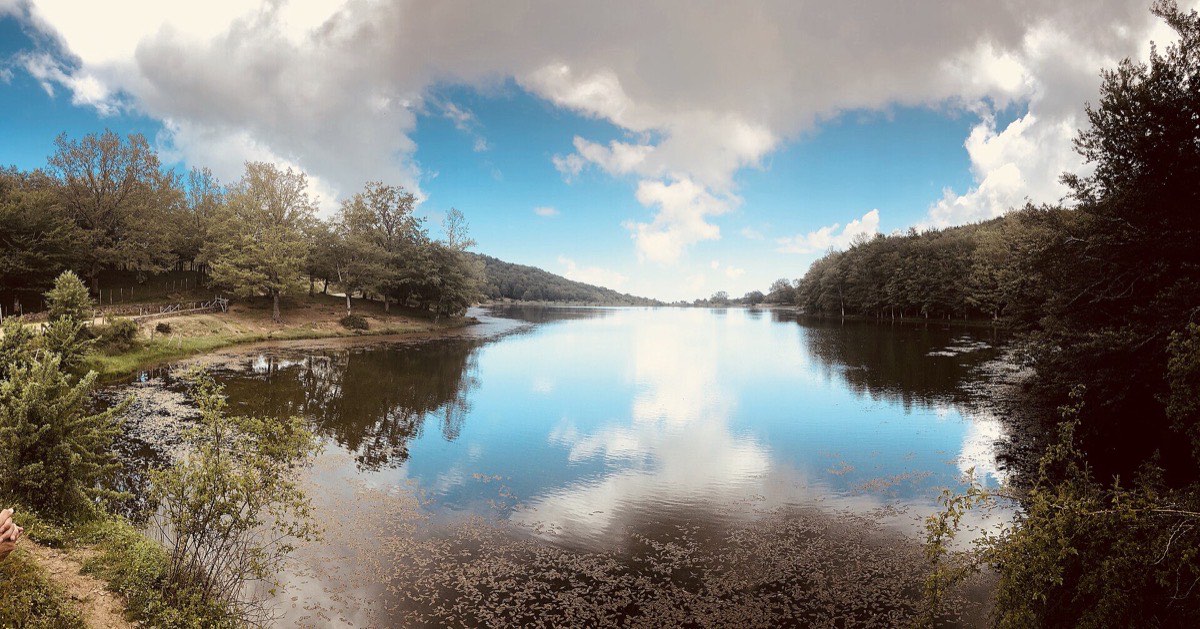
On this site we keep saying that the best time to walk in Sicily is March and April. The second good window is October and November, and it is far less busy. It is worth explaining why it is not simply spring seen in a mirror.
In spring the island is coming out of months of rain: the ground holds, the springs give water, the streams have flow. In autumn it is coming out of four dry months. It is the same landscape in two opposite hydrological conditions, and almost everything that follows comes from there.
When summer really ends
Not in September, and not by the calendar. On the coast September is still a summer month to all intents: the middle hours stay hard on the cliffs with no shade, and the problem of walking at dawn or not walking at all is still August’s problem.
The real change comes with the first serious weather system, which usually falls between the end of September and the middle of October but has no date. From that moment the middle hours become the good time instead of the time to avoid, and that reversal is what makes the season interesting.
The sea stays warm for a long time and keeps the coastal nights mild until well into November. On the reserves of the Trapani area and the south-east that means walking in a T-shirt in the middle of the morning, in October, with none of summer’s constraints.
The springs are at their lowest, not at their highest
This is the thing that most surprises anyone reasoning by seasons instead of by aquifers. After four months without recharge the aquifers are at the lowest point of the year, and the first rains do not fill them: they wet the soil, run off, evaporate. The recharge comes later, weeks or months behind the rain you can see falling.
The practical consequence is simple and should be taken literally. In October you carry all your water from home exactly as in August, even if it rains, even if the landscape looks green again. A fountain that gave water in March can be dry in October.
The first rain changes the ground, not just the weather
The limestone of the Iblei and the Madonie, when it gets wet after months of dust, turns slippery in a way that surprises anyone who knows those paths only in summer. The forest tracks of the Nebrodi and the Sicani, which have a clay surface, turn to real mud.
And the dry beds become watercourses again. The Iblean cave, the gorges cut into the limestone, and the fiumare, the seasonal torrent beds, have short response times: a valley floor you can walk in the morning may not be walkable in the afternoon, and the thing does not need rain above you, only rain upstream.
On 25 October the days shorten all at once
Summer time ends on Sunday 25 October 2026. Sunset moves back an hour from one day to the next: an afternoon outing that on Saturday the 24th finished in daylight finishes in the dark on Monday the 26th, leaving at the same time.
It sounds obvious put like that, and it is one of the most ordinary causes of calls to mountain rescue in autumn. On a linear route, where the way back has to be worked out separately, the turnaround time has to be fixed before setting out and kept to even when the destination is close.
Who you meet in the woods
From October the woods of the Nebrodi and the Madonie fill up with mushroom pickers. It is not a problem, but it changes the scene: forest tracks that are empty in summer have cars parked along them and people off the path, and at weekends the starting points fill up.
Picking requires the regional permit everywhere, and that permit is valid inside the parks too. If your aim is to walk and not to pick, the useful thing to know is simply that in those weeks it pays to set out early to find a space.
What opens
The coastal marshes of the south-east have water again, and with the water the birds come back. Vendicari in autumn is another place from Vendicari in August, and the difference is not one of nuance: in summer the marshes can be dry.
On Etna autumn is the good window before winter, with temperatures that make the climb bearable and visibility often better than in the summer haze. The rules on access to the summit zone do not change with the season, though, and have to be checked separately.
What closes
The seasonal services thin out. The bus runs towards the coastal reserves that had been added for the summer are withdrawn, and on the smaller islands some fast lines, classed as seasonal, stop altogether and the ship is what is left. Anyone travelling without a car has to redo the sums on the winter timetables instead of the ones they saw in August.
The period of highest fire danger closes in autumn, but the date is set each year by regional instruments and has to be checked at source. While the period is open the prohibitions stay in force, and so does the possibility of closures without notice.
In practice
Until the first rain you walk with August’s head: early, with shade, with all your water on you. After the first rain you walk with winter’s head: the middle hours, slippery ground, valley floors to think about, the way back worked out against darkness.
The crossing between the two seasons has no date on the calendar. It has a meteorological date, and it changes every year.
Real cases
Case
Cavagrande del Cassibile closes with a weather warning
The reserve drops into a cava, a gorge cut in the limestone, with pools on the floor, and the paths down are steep and carved into the rock. It is one of the places where the arrival of the autumn rains is felt straight away.
- The authority can close the reserve as a precaution when there is a weather warning, with a notice on its own website, and the floor of the gorge stays wet even after the rain has stopped.
- The closure concerns the descent into the gorge, where the wet ground and the flow in the pools are the problem.
- The Scala Cruci path, reopened in August 2024 after the works that followed the 2014 fire, has an entry ticket.
What this tells you. In autumn an alternative has to be thought out in advance, not looked for in the car park. If the plan is Cavagrande and a warning is in force, the chance of finding it shut is real: it is worth checking the authority’s closures page or having a second route in the area ready.
Cavagrande del CassibileCase
Why in October the fountain is dry even though it has rained
Anyone who knows the paths in spring takes it for granted that a spring marked on the map gives water. In autumn the same point may give nothing, and the rain of the previous days does not change the picture.
- Between May and September the aquifers receive no significant recharge and drop steadily.
- The first autumn rains rehydrate the soil and run off at the surface before soaking down deep.
- The rise in levels, and so the return of the springs, comes weeks or months behind the rain.
What this tells you. The green that comes back after the first rains tells you about the soil, not about the aquifer. Until late in the season the water you carry has to be worked out on summer’s figures.
Water and springsFrequently asked questions
Is autumn a good time to walk in Sicily?
It is the second good window of the year after March and April, and it is far less busy. After the first serious rain the middle hours become the best time instead of the time to avoid, and on the coast you walk in a T-shirt until well into November.
Will I find water at the springs in October?
As a rule no. After the summer the aquifers are at their lowest for the year and the recharge comes weeks or months behind the first rains. In October you carry all your water from home, as in August.
What changes on the paths after the first rains?
Wet limestone turns slippery, the clay forest tracks of the Nebrodi and the Sicani turn muddy, and the dry beds of the Iblean gorges and of the fiumare can carry water again. It is enough for it to rain upstream; it does not have to rain where you are walking.
When do the days get shorter?
Summer time ends on Sunday 25 October 2026: sunset moves back an hour from one day to the next. On a linear route the turnaround time has to be fixed before setting out.
The seasonal picture is described in general climatic terms, not as a forecast. The closures and the periods of prohibition cited are those declared by the managing authorities and have to be checked again at source before you set out, because they change every year by regional decree.
Written and checked by the Redazione Sentieri Siciliani. Published on 2 September 2026, updated on 2 September 2026. How we work.
Sources
- Servizio Meteorologico dell’Aeronautica Militare, the Italian Air Force weather service — official weather forecasts
- ISPRA, the national institute for environmental protection and research — protected areas, biodiversity and environmental data
- Protezione Civile della Regione Siciliana, the Sicilian civil protection department — weather warnings and forest fire risk notices for Sicily
- Parco dei Nebrodi, the Nebrodi park authority — access, forest tracks and the rules of the Nebrodi park
- ARPA Sicilia, the regional environmental protection agency — environmental data and water quality
Where to go from here
In more depth
Next step
From the principles to the places
Rules are worth little until they apply to a precise spot. From here you reach the pages with access points, parking and tracks.