Guide
Autumn woods in Sicily: where and when the leaves turn
In Sicily the leaves turn late and in few woods: beech, Turkey oak and oak woods above a thousand metres. The dates as the satellite measures them, the woods one by one, the rules and the routes.
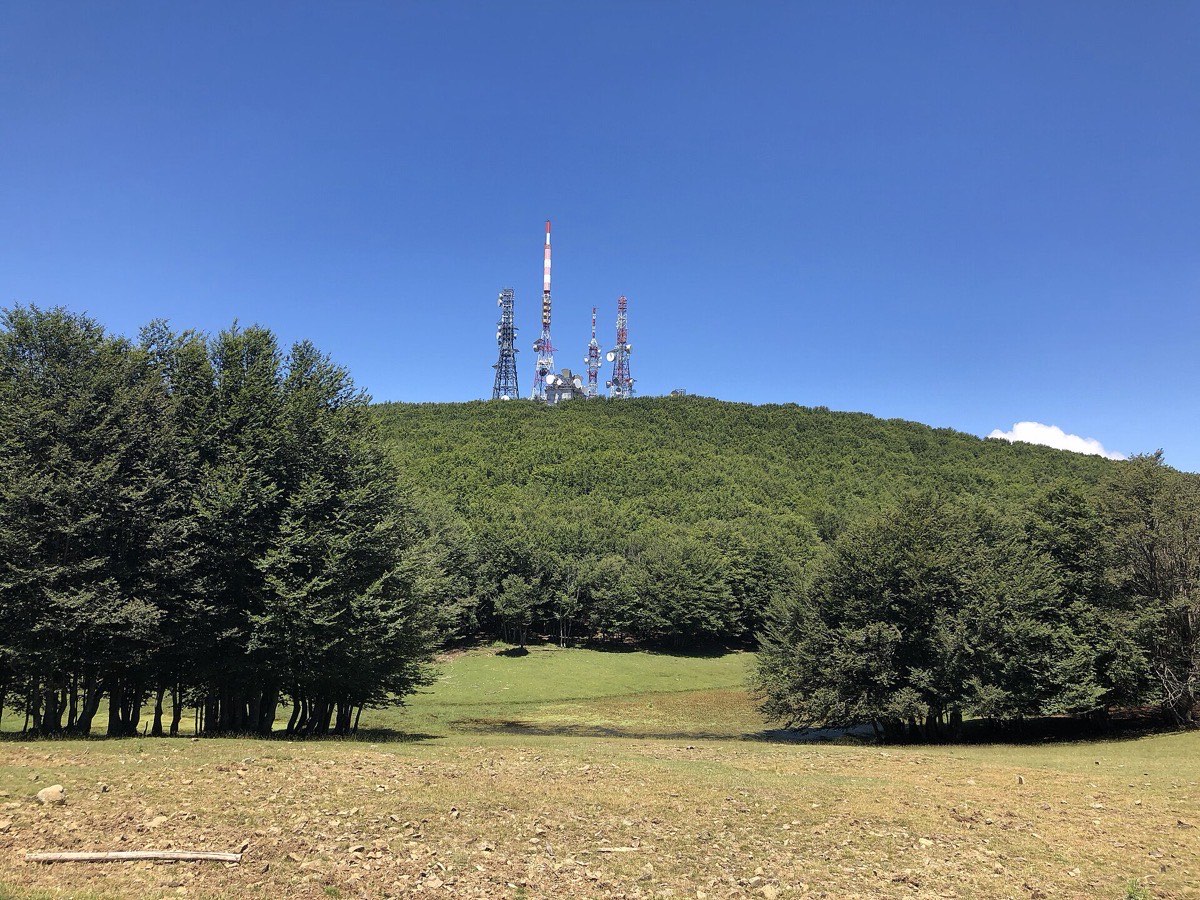
In Sicily the woods that change colour in autumn are few, they lie almost all above a thousand metres and they change late, because the yellow comes only where the tree drops its leaves. They are the beech woods (Fagus sylvatica) of the Nebrodi and of the Madonie, the woods of Turkey oak and of downy and sessile oak, and a few beech stands on Etna. Holm oak, cork oak, holly and the pines stay green, and where those are dominant the season does not show. This guide says when it happens, with dates measured from satellite, and then goes wood by wood: who runs it, what is prohibited, which route on this site crosses it.
When do the woods change colour in Sicily?
No Sicilian authority publishes a calendar of the leaves, and since a figure was needed all the same we worked one out ourselves. It comes from NASA’s MODIS MCD12Q2 product, which for every pixel of 500 m derives three dates a year from the satellite images: when greenness begins to fall, when it has lost half of its seasonal value, and when it comes close to its minimum. We kept only the pixels that the companion product MCD12Q1 classes as deciduous broadleaf or mixed forest, because elsewhere a fall in greenness says nothing about leaves coming down. The years looked at run from 2013 to 2023.
In the beech wood around Monte Soro, at about 1,700 m, greenness is halfway down its fall around 11 October (in half of the years between the 6th and the 15th) and reaches its minimum around 14 November (between the 8th and the 18th). At Malabotta, which lies lower, at about 1,100 m, the two dates are 14 October and 27 November. In the Madonie, at about 1,300 m along Sentiero 15, only one pixel in twenty-five comes out as deciduous or mixed woodland, so the 12 October and 24 November that result carry less weight than the other figures. On the north-west side of Etna, at 1,500 m near the Pista Altomontana, the pixels mix beech and evergreen Corsican pine. Since the pine does not turn yellow, the dates slip to 28 October and 6 December.
Two warnings. The first: the satellite measures green, not yellow or red. The window of colour therefore lies between the two dates, but the peak inside that window is not measured. The second: in the Nebrodi the first fall in greenness already arrives around the first of August, with the summer drought, so that a long summer can fade the leaves before their time. And from one year to the next the end of the fall in the Nebrodi has run from 5 November (2018) to 24 November (2023), that is, almost three weeks apart. In practice, for the high beech woods it is the second half of October and the first half of November, while for the lower oak woods you can go on to the end of November.
Which woods change colour, and which stay green?
The Parco dei Nebrodi describes a sequence by altitude that holds, with some variation, elsewhere too: up to 600-800 m the Mediterranean belt, between 800 and 1,200-1,400 m the deciduous oaks, above that the beech woods. Among the oaks the park names downy oak, sessile oak, *Quercus gussonei* and Turkey oak, which dominates in the cooler north-facing areas. In the highest beech woods, by contrast, beech grows almost pure, with the odd maple. These are the trees that turn yellow, so altitude is the first thing to look at when choosing where to go. Holm oak and cork oak do not, and neither does holly, which the park lists among the species of the understorey.
A useful index of where to go is the regional list of boschi vetusti, the ancient woods, established by decreto assessoriale no. 373 of 28 November 2024, an order of the regional department: twenty-one sites identified by the Corpo forestale, the forestry corps, with the University of Palermo, nearly all of them on state land. Of the twenty-one, eight are beech woods, two Turkey oak woods and three woods of downy or sessile oak, which is to say exactly the woods that change colour. That is why we name them in the sections that follow. The list opens no new path, though, because it was made for protection and not for access: anyone going there stays on the existing routes.
The beech woods of the Nebrodi: Monte Soro and the ridge
In the Nebrodi the beech woods cover the whole ridge for more than 10,000 hectares, according to the park, above 1,200-1,400 m, and Monte Soro, at 1,847 m, is their centre. Many of the ancient woods recognised in 2024 come from those same altitudes: the beech wood of Favarotta and the Bosco della Tassita at Caronia, the Turkey oak wood of Sant’Antonio and the beech wood of Sollazzotto at Capizzi. Then there are the beech woods of Serra del Re, Foresta Vecchia and Grappidà at Bronte, along with the Turkey oak wood of Semantile at Maniace.
Among our tracks the summit beech wood is crossed by the D345C Sollazzo Verde: 4.9 km between 1,564 and 1,776 m, 63 m of ascent and 371 m of descent, about two hours ten in the direction of the track. To Lago Maulazzo goes the D345E Sentiero dei Laghetti instead, 4.4 km between 1,351 and 1,686 m and about two hours. The D345A is only a link, 1.8 km, three quarters of an hour. Anyone who wants to see the full sequence, from the oaks to the beech, takes the D345 from Maniace to Portella Calacudera: 20.5 km between 667 and 1,833 m, 1,168 m of ascent and about eight hours. It also passes within half a kilometre of the locality of Semantile, the one with the Turkey oak wood. These are all linear tracks, so the return has to be counted separately.
Two rules have to be known before setting out. The first: the Parco dei Nebrodi page on access states that outings on foot, by bicycle or on horseback require prior authorisation, to be requested as a rule seven days in advance on the park’s form. Unauthorised activities, the same page adds, are liable to penalties. It draws no distinction between groups and individuals, so if in doubt it is worth writing to the access office. The second: on 15 July 2026 the park published the authorisation for the numerical control of wild boar in the province of Messina, for the period from 10 July to 31 December 2026. Those are exactly the months when people go to see the leaves, so autumn and the cull coincide.
The beech woods of the Madonie: Piano Battaglia, Piano Pomo, Cozzo Luminario
In the Madonie the beech sits on the high ground around Piano Battaglia, 1,572 m, and below Pizzo Carbonara. An altitude band for the beech woods, however, the park does not publish, and we are not going to invent one. Among the ancient woods are the holly wood of Piano Pomo and the sessile oak wood of Pomieri, which the list assigns to Petralia Sottana, then the beech wood of Cozzo Luminario and the holm oak wood of Monticelli at Castelbuono, along with the holm oak wood of Orippotto at Isnello. Of these, the oak wood of Pomieri and the beech wood of Cozzo Luminario change colour, while the hollies and the holm oak woods stay green.
The Sentiero Case la Pazza, Piano Pomo, Piano Sempria crosses Piano Pomo and passes some forty metres from the summit of Cozzo Luminario, according to the OpenStreetMap mapping. It is 6.5 km between 1,260 and 1,497 m, 379 m of ascent, about two hours thirty-five. Piano Pomo is also crossed by Sentiero 15, which is shorter: 4.7 km between 1,265 and 1,394 m and about one hour fifty. Anyone who prefers to start high up instead comes down from Piano Battaglia on the Sentiero Battaglietta, Piano Sempria, 8.1 km between 1,260 and 1,802 m, 747 m of ascent and 388 m of descent, nearly four hours in the direction of the track.
The rules of the Parco delle Madonie are in the list of prohibitions published on 27 June 2026: no picking of plants, no fires, no camping or bivouacking, no parking of vehicles outside the car parks, and a ban on crossing woods that have been through a fire. On 12 September 2026 a notice on old trees was added, asking people not to stop at the foot of large trees, because branches can come away even without wind. The same notice establishes that when a weather warning is in force for strong wind, heavy rain, thunderstorms or snow it is strictly prohibited to go into the woods. In autumn that is the commonest case, so the warning page counts for as much as the map.
Then there is the wildlife. The park puts the number of wild boar on its territory at between 1,500 and 3,000, and in its announcement of 11 September 2026 counted 224 selecontrollori, the trained cull marksmen. Operations with firearms are announced on the park’s site in daily notices giving the comune, the contrade, the outlying districts, and the hours, so that anyone on foot can keep away from them. The one of 10 September, for instance, flagged the contrade of Santa Caterina and Pollicino, from dawn to dusk. The evening before, you look at the notices page, and where there is a notice you do not go in.
Bosco di Malabotta: beech and Turkey oak above Montalbano Elicona
The riserva naturale orientata Bosco di Malabotta, a managed nature reserve, was established by decree of 25 July 1997 in the comuni of Montalbano Elicona, Roccella Valdemone, Malvagna, Francavilla di Sicilia and Tripi, that is, astride the Nebrodi and the Peloritani. The regional ORBS portal gives it 3,221.95 hectares and names as its managing body the Dipartimento dello Sviluppo rurale e territoriale, which inherited the task from the Azienda foreste demaniali named in the decree. Inside the OpenStreetMap boundary the digital terrain model runs from about 690 to about 1,320 m. It therefore lies lower than the beech woods of the Nebrodi, and changes colour later.
The decree says why it is protected: a beech wood with holly, with elements of the deciduous oak woods and vegetation along the streams. The ORBS page adds Turkey oak, which dominates over about 80 hectares, beech, sweet chestnut and holly, and in 2024 the wood entered the list of ancient woods. Among the broadleaved woods we measured it is the one that reaches the end of its fall in greenness latest, around 27 November. Only Etna goes beyond that, but there the pines distort the figure, so Malabotta is the place to go when the leaves in the Nebrodi have already fallen.
The regulations attached to the decree prohibit, in zone A, leaving the routes specially laid out, camping or bivouacking, lighting fires, bringing in weapons and taking away plants. The picking of mushrooms and wild fruit, on the other hand, the managing body may regulate. What those routes are, though, we have not managed to find out. A page from the body with access points, car parks or paths we have not found, and the site riservamalabotta.it today does not answer. Since there is no track for Malabotta on our site either, before going you ask the managing body which routes are laid out.
Monte Genuardo e Santa Maria del Bosco: downy oaks in the Sicani
The Monte Genuardo e Santa Maria del Bosco reserve came into being by decree of that same 25 July 1997, between Contessa Entellina, Giuliana and Sambuca di Sicilia, and ORBS gives it 2,552.91 hectares, with the same managing body as Malabotta. The decree establishes it for a wood made up for the most part of holm oak, of *Quercus virgiliana*, one of the downy oaks, and of whitebeam. It is therefore a wood that in autumn stays green nearly everywhere. The Parks.it page gives Monte Genuardo 1,180 m. On the south side it describes a dense holm oak wood broken by stands of downy oak, field maple and manna ash, while to the north-west it reports natural woodland mixed with plantations of non-native species.
Here the colour comes in patches and not in sweeps, because the downy oaks turn yellow inside a wood that stays largely green. The downy oak wood of Santa Maria del Bosco, at Contessa Entellina, is among the ancient woods of 2024. Since the satellite pixels are mixed, with conifers and evergreens, the dates are less clear-cut as well: halfway down the fall around 9 October, the end around 24 November, with a great deal of variation from one year to the next. The scheme of the regulations follows that of Malabotta, including the prohibition on leaving the routes laid out in zone A. But the question stays the same and unanswered: a track for Genuardo we do not have, and a list of paths published by the body we have not found.
Bosco di Santo Pietro: a cork oak wood, which is to say an evergreen one
The Bosco di Santo Pietro, between Caltagirone and Mazzarrone, has been a reserve since decree no. 116/44 of 23 March 1999, which entrusted its management to the Azienda regionale foreste demaniali and approved the regulations. The boundary was later changed by the decree of 22 December 2003, and Parks.it gives it 6,559.38 hectares. The European MedMaquis project, in a news item of 31 May 2026, describes it as the largest cork oak wood in south-central Sicily, with cork oak and holm oak dominant, and recalls that in recent years fires have destroyed hundreds of hectares. The state of the wood, for that reason, has to be asked about before setting out.
Anyone looking for the yellow of the beeches will not find it here, because cork oak and holm oak do not drop their leaves and the wood lies low, roughly between 70 and 310 m in the wooded area mapped on OpenStreetMap. At Santo Pietro, indeed, autumn works the other way round. On the open ground at the point we measured, in the middle of the mapped area, the satellite records the start of the return of the green around 25 October, that is, with the first rains, when the grass starts again and the landscape turns green while in the mountains it is turning yellow. That makes it a good place to go when there is a warning or fog on the high ground. We were not able to read the 1999 regulations, and a track we do not have. Parks.it mentions the Vaccarizzo path.
Ficuzza, Etna and the chestnut woods: the other autumn woods
The Bosco della Ficuzza, below Rocca Busambra, is a mosaic, where cork oak dominates between 500 and 900 m and holm oak sits higher, while downy oak and Gussone’s oak put in the patches of yellow. The downy oak wood of Fanuso, at Godrano, is on the list of ancient woods. The simplest route on the site is Ficuzza, vecchia stazione e Gorgo del Drago, 3.6 km between 644 and 750 m and about an hour and a quarter on the way out, on shaded forest tracks. There is little climbing, so half a day is enough.
On Etna the park places beech at around 2,000 m, where it reaches its southern limit and its highest altitudes, together with the Etna birch, while lower down there are woods of oak and sweet chestnut. Among the ancient woods is the beech wood of Monte Spagnolo, at Randazzo, and the Pista Altomontana passes close to it, 34.2 km between 1,416 and 1,940 m, which according to the OpenStreetMap mapping comes within about 370 m of the summit. In full it is more than eleven hours, so it is done in sections. For the chestnut woods of the east side, the ottobrate festivals and the rules on picking chestnuts there is a guide of its own.
Before setting out: light, rain, firearms
Light first of all. Summer time ended on Sunday 25 October 2026, and from that day the afternoon shortened at a stroke. At Piano Battaglia, with a clear horizon, the sun sets at 18:16 on 24 October, at 17:13 on the 26th and at 16:54 on 15 November, while in a valley or inside a beech wood the dark comes earlier. These are our own astronomical calculations, not an authority’s times. On a linear route the time to turn back is decided before setting out, because the return costs as much as the way out.
Then the rain. Wet leaves on forest tracks are slippery, the clay ground of the Nebrodi turns to mud and low cloud on the ridges takes away visibility within minutes. The warning from the regional civil protection service is therefore looked at the day before, and in the Madonie, if it is for wind, heavy rain, thunderstorms or snow, the park prohibits going into the woods at all.
That leaves the firearms and the baskets. The hunting season opens in Sicily on 20 September, but in the Malabotta and Genuardo reserves the regulations prohibit it, and so does the Parco delle Madonie. Inside these areas shooting takes place only for the control of wild boar, which the authorities announce case by case. For mushrooms, on the other hand, in Sicilian woods you need the tesserino, the regional permit card. In the Malabotta and Genuardo reserves the regulations allow the body to restrict picking further, while in the Madonie the park prohibits the picking of plants.
In practice
For the high beech woods of the Nebrodi and the Madonie the window runs from mid-October to mid-November, with the best of it usually across the turn of the two months. At Malabotta and in the lower oak woods, by contrast, you can wait until the end of November. In the Nebrodi the park authorisation is requested a week in advance; in the Madonie you look at the weather warning and at the notices page the evening before. For the three regional reserves, that is Malabotta, Genuardo and Santo Pietro, you ask the managing body which routes are open, because there leaving the routes laid out is prohibited.
Real cases
Case
Twenty-one ancient woods, and which of them change colour
In November 2024 the region established the list of boschi vetusti, the ancient woods. It is the most up-to-date map of the mature woodland on the island, and it also says which species make them up.
- The decreto assessoriale no. 373 is of 28 November 2024; the list is kept by the Comando del Corpo forestale, the forestry corps headquarters.
- There are twenty-one sites, in the provinces of Palermo, Messina, Catania and Siracusa, identified in 2024 with the University of Palermo, for the most part on state land.
- Eight are beech woods: Cozzo Luminario, Favarotta, Sollazzotto, Serra del Re, Foresta Vecchia, Grappidà, Fago Scuro and Monte Spagnolo.
- Two are Turkey oak woods (Sant’Antonio and Semantile) and three are woods of downy or sessile oak (Santa Maria del Bosco, Fanuso, Pomieri); to these Malabotta is added.
- The rest are the holm oak woods of Monticelli and Orippotto, the Corsican pine wood of Ragabo, the wood of Corsican pine and downy oak of Monte Egitto, the holly wood of Piano Pomo, the Bosco della Tassita and the cork oak wood of Capotumino: for the most part woods that in autumn stay green.
What this tells you. A list established for protection also works as a map of the colours: the beech and oak woods on the list are the places where autumn shows. It remains a list for protection and not for walking: you go in only where there are routes.
Monte SoroCase
In the Nebrodi the end of the green swings by three weeks
We extracted from the MODIS MCD12Q2 product the dates for the end of the fall in greenness for the beech wood pixels around Monte Soro, year by year.
- The area is a grid of 25 pixels of 500 m centred at about 1,700 m of altitude; 16 of them are classed as deciduous broadleaf forest.
- The median for the end of the fall is 14 November over the eleven years from 2013 to 2023.
- The earliest year is 2018, with 5 November; the latest 2023, with 24 November.
- In 2015, 2016 and 2020 the end of the fall came between 7 and 8 November; in 2013, 2014 and 2021 between the 16th and the 20th.
- The first fall in greenness usually arrives between the end of July and the beginning of August, with the summer drought.
What this tells you. A fixed date for the colours does not exist. Anyone who can choose looks at how the year has gone and keeps a margin of two weeks either side of the start of November.
The NebrodiCase
Madonie, September 2026: two notices before the season
At the start of autumn 2026 the Parco delle Madonie published two kinds of notice that bear directly on anyone going into the woods.
- On 10 and 15 September 2026 the park published Zona di pericolo notices, danger zone notices, for wildlife control with firearms at Petralia Sottana, Petralia Soprana and Geraci Siculo, from dawn to dusk.
- In an announcement of 11 September the park made public its request to the region for a state of emergency over fallow deer and wild boar, approved unanimously by its council; there were 224 cull marksmen.
- On 12 September the park published a notice on monumental trees: no stopping at the foot of the large trees, branches that can fall even without wind.
- The same notice prohibits going into the woods when there is a weather warning for strong wind, heavy rain, thunderstorms or snow.
What this tells you. In the woods of the Madonie conditions change from day to day. The park’s notices page has to be read the evening before, like the warning bulletin.
Piano BattagliaCase
Monte Genuardo, August 2025: the fire beside the reserve
The downy oak wood of Santa Maria del Bosco is an ancient wood, and it stands in country where summer brings fires.
- On 29 August 2025 a fire developed in the countryside of Contessa Entellina, very close to the Monte Genuardo e Santa Maria del Bosco reserve.
- Two Canadair, a helicopter, the Vigili del fuoco, the fire brigade, and teams from the Corpo forestale were called out.
- According to the mayor the reserve had not been touched by the flames.
- The regulations of the Parco delle Madonie, by way of comparison, prohibit crossing woods that have been through a fire.
What this tells you. The autumn woods are often the same ones that risk burning in summer. A wood hit by a fire is not crossed, and its condition has to be asked about from the authority before setting out.
Fires and closuresFrequently asked questions
When can you see the autumn colours in Sicily?
In the beech woods of the Nebrodi and the Madonie, between mid-October and mid-November. The MODIS satellite data from 2013 to 2023 put the halfway point of the fall in greenness in the Nebrodi around 11 October and the end around 14 November. In the lower oak woods, such as Malabotta, the end comes towards 27 November. From one year to the next the dates shift by as much as three weeks.
Where can you see the autumn colours in Sicily?
In the beech woods above 1,200-1,400 m in the Nebrodi, around Monte Soro, and in the Madonie, around Piano Battaglia and Piano Pomo. Then at Malabotta, with beech and Turkey oak, in the downy oak woods of Monte Genuardo and of the Ficuzza, and on Etna in the beech wood of Monte Spagnolo. The holm oak and cork oak woods stay green.
How do you visit the Bosco di Malabotta?
It is a riserva naturale orientata, a managed nature reserve, run by the regional Dipartimento dello Sviluppo rurale e territoriale. The regulations prohibit, in zone A, leaving the routes laid out, camping and lighting fires. We have not found an official page with access points and paths, nor a ticket: which routes are open has to be asked of the managing body before setting out.
Does the Bosco di Santo Pietro change colour in autumn?
Hardly. It is above all a cork oak wood with holm oak, trees that do not drop their leaves, low down between Caltagirone and Mazzarrone. In autumn the green comes back here: with the first rains the grass starts again, and the satellite records the beginning of the greening around 25 October. It is a place for mild days, not for colour.
How high is Monte Genuardo and what wood is there?
Monte Genuardo is given as 1,180 m. The reserve protects a wood of holm oak, downy oak and whitebeam, with field maple and manna ash and, to the north-west, plantations of non-native species. The downy oak wood of Santa Maria del Bosco has been an ancient wood since 2024. The colour comes in patches inside an evergreen holm oak wood.
Do you need a permit to walk in the Parco dei Nebrodi?
The park’s page on access says yes: outings on foot, by bicycle or on horseback require prior authorisation, to be requested as a rule seven days in advance on the park’s form. The page draws no distinction between groups and individuals. For queries the point of contact is the park’s access office at Caronia.
Can you go into the woods of the Madonie when there is a weather warning?
No. By the notice of 12 September 2026 the Parco delle Madonie prohibits going into the woods and passing close to the large trees when there is a warning for strong wind, heavy rain, thunderstorms or snow. The risk is branches and trees coming down. The warning from the regional civil protection service is checked the day before.
Can you pick mushrooms and leaves in the protected woods?
In the Madonie the park prohibits picking or taking away plants of any kind. In the Malabotta and Genuardo reserves the regulations prohibit taking away plants and allow the body to regulate the picking of mushrooms and wild fruit. For mushrooms in Sicily you need the tesserino, the regional permit card, in any case.
Is there shooting in the autumn woods?
In the Malabotta and Genuardo reserves and in the Parco delle Madonie hunting is prohibited, but the parks authorise the control of wild boar with firearms. In the Nebrodi the control in the province of Messina is authorised until 31 December 2026; in the Madonie the operations are announced in daily notices giving the contrade and the hours. Outside the protected areas the hunting season has been open since 20 September.
Read on 17 September 2026: the founding decrees and the regulations of the Bosco di Malabotta and Monte Genuardo e Santa Maria del Bosco reserves (GURS 1998), the decree of 22 December 2003 on the Bosco di Santo Pietro reserve (GURS no. 5/2004), the ORBS and Parks.it pages for the three reserves, the regional announcement of 28 November 2024 on the list of boschi vetusti, the ancient woods, the pages of the Parco dei Nebrodi (vegetation belts, authorisation to visit, the notice on wild boar of 15 July 2026), of the Parco delle Madonie (prohibitions, the notice on trees of 12 September 2026, the wildlife control notices) and of the Parco dell’Etna. The dates for the colours are our own working of NASA’s MODIS MCD12Q2 satellite product, years 2013 to 2023, extracted from the ORNL DAAC service: it measures greenness, not colour, at 500 m resolution. Altitudes and height gain for the routes come from the tracks on this site; the altitudes of the reserves from the EU-DEM digital terrain model queried on OpenTopoData inside the OpenStreetMap boundaries. We were not able to read the 1999 regulations for Santo Pietro, nor the regional page for the Malabotta ancient wood, which is no longer online; the site riservamalabotta.it does not answer. No authority publishes a calendar of the autumn colours: the dates here are averages over eleven years, not a forecast.
Written and checked by the Redazione Sentieri Siciliani. Published on 14 October 2026, updated on 14 October 2026. How we work.
Sources
- NASA LP DAAC, MODIS MCD12Q2 v061 product, Land Cover Dynamics — the annual dates for the start, the mid-point and the end of the decline in the greenness of the vegetation, on 500 m pixels, used for the window of the colours
- NASA LP DAAC, MODIS MCD12Q1 v061 product, Land Cover Type — the land cover class of each pixel, so as to keep only the deciduous broadleaf and mixed woods
- ORNL DAAC, MODIS/VIIRS Land Product Subsets service — the extraction of the MCD12Q2 and MCD12Q1 values around the woods in this guide, queried on 17 September 2026
- Regione Siciliana, press release of 28 November 2024 on the regional register of old-growth woods — the 21 old-growth woods of Sicily with their species and their comuni: beech woods, Turkey oak woods, downy oak and sessile oak woods, hollies
- Regione Siciliana, Comando del Corpo forestale, the command of the regional forestry corps, page on the old-growth woods of Sicily — the body responsible for the register of old-growth woods, and D.A. n. 373 of 28 November 2024, the decree that establishes it
- Gazzetta Ufficiale della Regione Siciliana, the official gazette of the Sicilian region, 1998, supplement carrying the decrees of 25 July 1997 that establish the reserves — the establishing decrees and the regulations of the Bosco di Malabotta and Monte Genuardo e Santa Maria del Bosco reserves: their purpose, the managing authority, the bans
- Gazzetta Ufficiale della Regione Siciliana, the official gazette of the Sicilian region, no. 5 of 30 January 2004, decree of 22 December 2003 — the establishment of the Bosco di Santo Pietro reserve (decree n. 116/44 of 23 March 1999), the managing authority, the regulation in force and the new boundary
- Regione Siciliana, ORBS portal, page on the Riserva Naturale Orientata Bosco di Malabotta — the area, the comuni, the managing authority and the tree species of the reserve
- Regione Siciliana, ORBS portal, page on the Riserva Naturale Monte Genuardo e Santa Maria del Bosco — the area, the comuni, the managing authority and the plant communities of the reserve
- Parks.it, page on the Riserva Naturale Orientata Monte Genuardo e Santa Maria del Bosco — the height of Monte Genuardo, the holm oak wood, the stands of downy oak and the plantations
- Parks.it, page on the Riserva Naturale Orientata Bosco di Santo Pietro — the area, the year it was established, the cork oaks and the Vaccarizzo path
- Fondazione AVSI, MedMaquis project, Interreg VI-A Italy-Malta, news item of 31 May 2026 — cork oak and holm oak as the dominant species at Santo Pietro, and the fires of recent years
- Ente Parco dei Nebrodi, the Nebrodi park authority, page on the protected area on Parks.it — the vegetation belts by height, the extent of the beech woods, and Turkey oak, sessile oak, downy oak and Quercus gussonei
- Parco dei Nebrodi, the Nebrodi park authority, its page on permission to visit — permission to be obtained before an outing, as a rule seven days ahead, under art. 17 of the establishing decree
- Parco dei Nebrodi, the Nebrodi park authority, notice of 15 July 2026 on the numerical control of wild pigs in the province of Messina — the wild boar control period, from 10 July to 31 December 2026
- Parco delle Madonie, the Madonie park authority, regulation on the use of the park: the list of bans, 27 June 2026 — the bans on picking, on fires, on camping, on walking in burnt woodland and on parking outside the car parks
- Parco delle Madonie, the Madonie park authority, notice to walkers on monumental trees, 12 September 2026 — the ban on going into the woods when a weather warning is in force, and keeping away from large trees
- Parco delle Madonie, the Madonie park authority, press release of 11 September 2026 on its request to the region for a state of emergency over fallow deer and wild boar — the number of selecontrollori, the marksmen trained for selective culling, active in the park
- Parco delle Madonie, the Madonie park authority, Zona di pericolo notice, the danger-zone notice, of 10 September 2026 — the form these notices of wildlife control with firearms take, with their contrade, the outlying districts, and their times
- Parco delle Madonie, the Madonie park authority, its page on wildlife management — the estimate of the wild pig population in the park
- Parco dell’Etna, the Etna park authority, its page on the environment and the territory — beech at its southern limit at around 2,000 m, and birch, oaks and chestnuts at the lower levels
- ANSA, news item of 29 August 2025 on the fire at Contessa Entellina — the fire near the Monte Genuardo reserve, the machines deployed and the mayor’s statement
- Parco dei Nebrodi, the Nebrodi park authority — access, forest tracks and the rules of the Nebrodi park
- Parco delle Madonie, the Madonie park authority — the path network, the rules and the state of the routes in the Madonie
- Protezione Civile della Regione Siciliana, the Sicilian civil protection department — weather warnings and forest fire risk notices for Sicily
- OpenTopoData — queries against the digital terrain models used for heights and ascent
- OpenStreetMap — the geometries of the routes published on this site, under the ODbL licence
Where to go from here
In the same series
Next step
From the principles to the places
Rules are worth little until they apply to a precise spot. From here you reach the pages with access points, parking and tracks.